
Cash Flow Management: Survive Mission Gaps
As of 2026-11-07
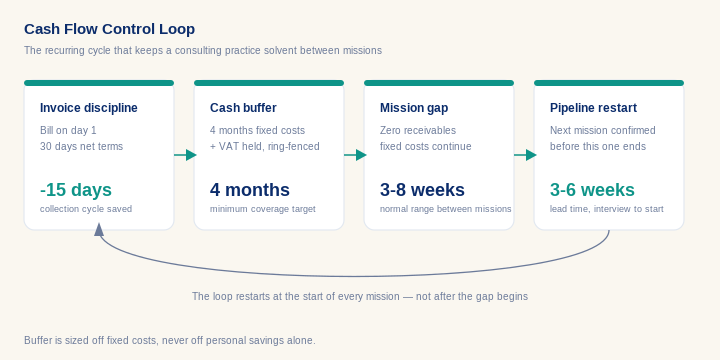
A late invoice or an unpriced 60-day payment term drains cash at the worst moment and cannot be fixed afterwards; its cost per billed day (about 0.011 R in the module's example) is smaller than that of a weak rate negotiation, but it lands when the buffer is thin. This module sets the numbers that matter: a buffer of 4 months of fixed costs plus the VAT held (about €29,900 in the module's €150,000-a-year example, assumptions labelled), to which the next IS instalment is added; invoicing on performance, as article L441-9 of the Code de commerce requires, with terms capped at 60 days or 45 days end of month (L441-10); the IS calendar of 15 March, 15 June, 15 September, 15 December and a balance on 15 May; and the H2 2026 default penalty rate of 12.40% plus a €40 indemnity. It also reframes the rate conversation: payment terms are part of your effective rate.
What you will learn
- Calculate the minimum cash buffer required for a French SAP consultant operating through an IS-regime SASU, accounting for fixed costs, VAT float, and corporate tax advance payment schedules
- Apply invoicing discipline — timing, payment terms selection, and active chase protocols — to reduce average collection cycles and prevent the most common self-inflicted cash flow delays
- Design a gap-management strategy that includes advance pipeline planning, a dedicated transition fund, and revenue-smoothing mechanisms such as milestone billing and retainer agreements
- Integrate fiscal timing events (IS acomptes, URSSAF regularisation, PAS adjustments) into annual cash flow planning so tax deadlines never coincide with empty receivables
The Consultant's Cash Flow Reality
Consulting cash flow is structurally lumpy in a way that employment income is not. An employee is paid on a fixed day every month whatever happens on the project. A consultant invoices when the service is performed, waits for the payment term, and between missions receives nothing while fixed costs keep running. Managing that asymmetry is an operating skill, not a personality trait.
Prerequisites
- Review core concepts first: C069, C071, C076
Outcomes
- Build a 13-week rolling cash forecast updated weekly.
- Maintain a cash buffer of at least 4 months of fixed costs plus VAT held plus the next IS instalment, raised to 6 months of fixed costs if missions are irregular or public-sector-heavy, with VAT and tax in separate sub-accounts.
- Apply the module's core decision: How big should the cash buffer be — choose: 4 months of fixed costs plus VAT held plus the next IS instalment as the floor; move to 6 months of fixed costs if missions are irregular, public-sector-heavy, or you have dependents relying on the draw; avoid: counting the VAT collected from clients as part of the buffer, because it is a liability, not operating cash, and belongs in a separate sub-account.
- Track mastery with the KPI: Cash buffer coverage (target: >= 4 months of fixed costs, with the VAT held and the next IS instalment kept on top; red flag: < 2 months means one late-paying client or one IS acompte falling in a gap can force an emergency draw).
Full module with the Consultant plan — €19.90/month. The full module adds: the decision framework · the end-to-end scenario walkthrough · the KPI scorecard · the anti-patterns · the code blocks · the knowledge check · the diagrams.