Invoicing: Timing, Penalties, Collection
As of 2026-10-03
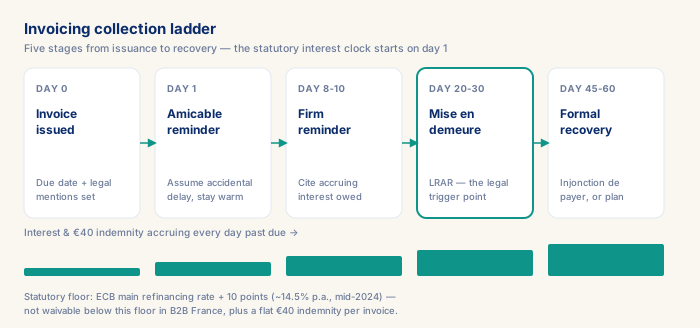
Invoicing discipline is a cash-flow control, not paperwork: French law caps B2B payment terms at 60 days (or 45 days end-of-month), and any missing mandatory mention — especially the due date or the penalty clause — weakens your legal position exactly when a client stops paying. The number that matters: every month you invoice at month-end instead of on completion, you gift the client up to 30 days of float, and every day past the due date you are owed interest at the ECB main refinancing rate plus 10 points (a statutory floor of roughly 14.5% per annum as of mid-2024) plus a mandatory €40 fixed indemnity. The decision a partner opens with: lock 30-day terms and invoice-on-completion by default, concede upward only when you hold leverage, and never accept 100%-on-delivery invoicing on a multi-month engagement. Get the collection ladder right — amicable reminder, firm reminder, mise en demeure by registered post, then injonction de payer — and most late payments resolve before a lawyer is ever needed.
What you will learn
- List the mandatory legal mentions required on a French B2B invoice and identify which are most commonly missing or disputed
- Explain how EU Directive 2011/7/EU late-payment interest and the €40 fixed indemnity work in French B2B practice
- Structure milestone invoicing and payment terms to reduce exposure and cash-flow risk on multi-month projects
- Execute a four-step collection ladder that recovers overdue payment before requiring legal proceedings
Why invoicing discipline is a cash-flow pillar, not admin overhead
For an SAP analytics consultant running a SASU, clean invoicing practice is not bureaucratic box-ticking. It is the mechanism that determines when money enters your account, whether late-payment penalties are legally enforceable, and — when a client does not pay — how strong your legal position is. A missing mention on an invoice can nullify your right to interest. A vague payment-terms clause can cost you 30 days of float every month on a €15,000 invoice.
The sections below map what French law requires on an invoice, how EU-derived late-payment rules actually work in practice, how to build a collection ladder that recovers payment before you need a lawyer, and the timing questions that affect cash flow most.
Prerequisites
- Review core concepts first: C087, C071, C063
Outcomes
- Include all French mandatory mentions on every invoice.
- Apply the "1st of month" invoicing discipline rigorously.
- Apply the module's core decision: Default payment terms to open with — choose Open at 30 days net.
- Track mastery with the KPI: Days Sales Outstanding (DSO) (target: <= 35 days average across invoices).
Full module available to members. The full module adds: the decision framework · the end-to-end scenario walkthrough · the KPI scorecard · the anti-patterns · the knowledge check · the diagrams.