International Freelance: Tax Optimization Abroad
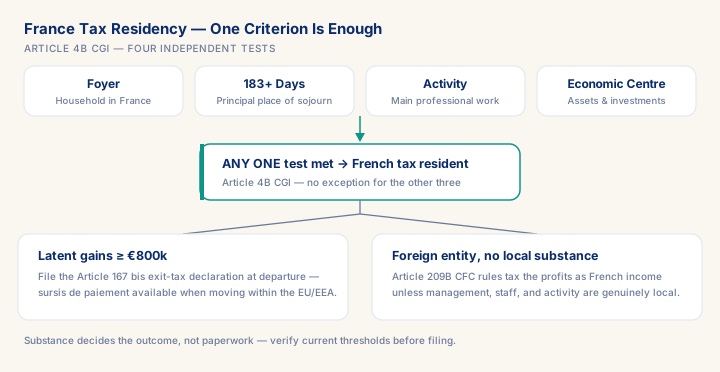
As of 2026-10-10
Relocating abroad only lowers tax if the move survives France's four-criterion residency test — meet just one of foyer, 183 days, professional activity, or economic centre, and France keeps taxing you at French rates regardless of where you live. The number that decides most cases: the €800,000 threshold on latent gains under Article 167 bis, which triggers a mandatory exit-tax declaration the day you leave, whether or not you owe anything. Every popular jurisdiction — Portugal's IFICI, Dubai, Andorra, Bulgaria, Cyprus non-dom — advertises a headline rate that assumes full family departure and genuine local substance; a French client base and a spouse left in Paris void the arrangement and expose the freelancer to a CFC reassessment under Article 209B. The career stake: a consultant who can explain, in one sentence, why they stay on a French SASU rather than chase a lower headline rate signals exactly the legal maturity that justifies a premium day-rate.
What you will learn
- Apply France's four-criterion tax residency test (foyer, 183 days, professional activity, economic centre) to a consultant's personal situation
- Assess the real substance requirements for the five most-cited jurisdictions (Portugal, UAE, Andorra, Bulgaria, Cyprus)
- Identify when French exit tax applies and the declaration obligations when departing with latent gains
- Distinguish legitimate international structuring from artificial schemes targeted by Article 209B CFC rules
Not professional advice. International tax residency involves complex bilateral tax treaties and domestic anti-avoidance rules that change regularly. The consequences of getting this wrong — back taxes, penalties, criminal prosecution in extreme cases — are severe. Consult a tax lawyer or chartered accountant specialising in international mobility before taking any structural decision.
The gap between the narrative and the reality
The digital-nomad tax-optimisation content circulating online is almost uniformly structured around best-case scenarios: Portugal at 20% flat rate, Dubai at 0%, Andorra at 10%, Bulgaria at 10%, Cyprus non-dom. The mathematics work if you accept a set of conditions that are routinely glossed over: genuine physical presence, fully severed family ties in France, real economic substance in the new jurisdiction, and compliance with French exit-tax rules. The gap between the narrative and the legal reality is where most consultants — including experienced SAP professionals — make expensive mistakes.
What follows: how French tax residency actually works, what the real requirements are for each commonly cited jurisdiction, what France does when it suspects an artificial departure, and how to think about the legitimate cases where international structuring makes sense.
Prerequisites
- Intermediate hands-on experience on SAP analytics projects
- Review core concepts first: C075, C073, C068
Outcomes
- Understand effective tax residency vs administrative residency.
- Apply the French tests (home, 183 days, family, economic ties).
- Apply the module's core decision: Whether to pursue international relocation at all — choose Relocate only when family, home, and economic life move too.
- Track mastery with the KPI: Residency criteria still met (target: 0 of 4 Article 4B criteria).
Full module available to members. The full module adds: the decision framework · the end-to-end scenario walkthrough · the KPI scorecard · the anti-patterns · the knowledge check · the diagrams.