LinkedIn Monitoring: Lists, Alerts, Signal
As of 2026-10-03
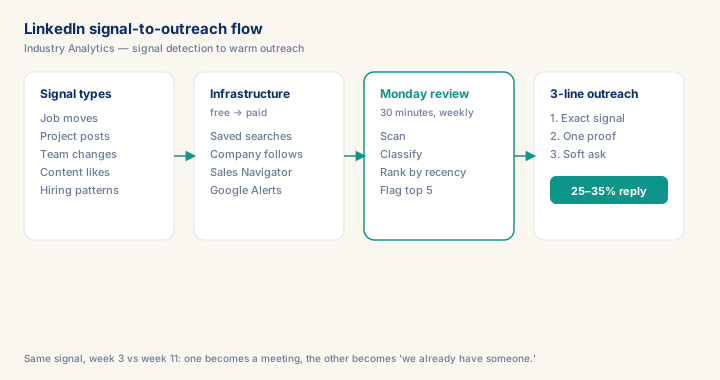
By the time an RFP for a SAP analytics programme is public, the shortlist is already set — LinkedIn signal tracking is how you get inside that window 90 days earlier, while the brief is still being written. Five signal types (executive job moves, project announcements, team restructuring, content engagement, hiring patterns) are visible for free or for the roughly €80–120/month cost of a Sales Navigator seat, and a disciplined Monday 30-minute review is what turns them into outreach before the decision hardens. The lever is response rate, not volume: a three-line message that names the exact signal converts at 25–35% among first-degree contacts, against under 5% for generic cold outreach. For a consultant whose day rate depends on getting to the table before the RFP stage, this is the difference between bidding on a defined scope and shaping one.
What you will learn
- Identify and classify the five LinkedIn signal types — executive job moves, project announcements, team changes, content engagement, and hiring patterns — that indicate a live SAP analytics buying decision
- Build a three-layer monitoring infrastructure (saved searches, company follows, Sales Navigator lists) that surfaces relevant signals without requiring daily active attention
- Execute the Monday 30-minute review ritual: scan, classify, and convert signals into targeted three-line outreach messages before the decision window closes
- Apply the three-line outreach format — specific signal, relevant experience, low-friction offer — to achieve 25–35% response rates among warm contacts
The consultant who waits for an RFP to surface before making contact is already three months behind. By the time a buying decision is visible, the shortlist is formed. LinkedIn monitoring is the discipline that lets you identify the decision 90 days before the RFP — when you can still shape the brief.
The five signal types worth tracking
Executive job moves are the most predictable trigger. A new CDO or head of analytics at a DACH manufacturer has a mandate to prove themselves in the first 90 days. That mandate almost always involves a technology assessment. A Datasphere or BW/4HANA specialist who reaches out in week three — not week twelve — of that new appointment is the one who shapes the conversation. Set up LinkedIn alerts on job title changes for the 30–50 firms in your target market. The alert fires within 24 hours of the profile update.
Prerequisites
- Review core concepts first: C058, C045, C082
Outcomes
- Classify a LinkedIn signal into one of five types — job move, project announcement, team change, content engagement, hiring pattern — within seconds of seeing it.
- Build a free-tier monitoring base (3 saved searches, 50 company follows) before deciding whether a €80–120/month Sales Navigator seat is worth it.
- Run the Monday 30-minute review end to end: scan, classify, rank by recency, flag the week's top 5 contacts.
- Write a three-line outreach message — specific signal, relevant proof, low-friction offer — built to reach a 25–35% response rate on first-degree contacts.
Full module available to members. The full module adds: the decision framework · the end-to-end scenario walkthrough · the KPI scorecard · the anti-patterns · the knowledge check · the diagrams.