Reading Gartner, Forrester, BARC, IDC
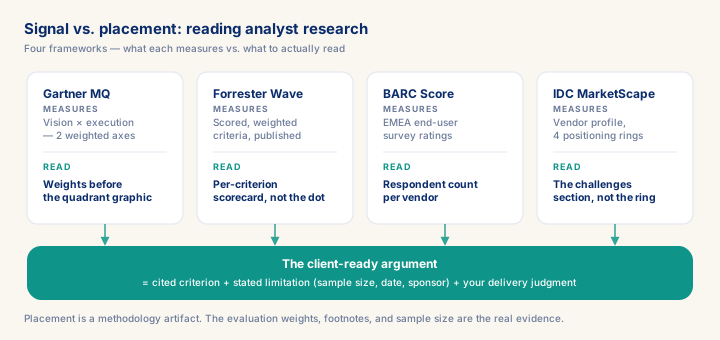
As of 2026-10-03
A "Gartner Leader" badge on a vendor slide is not evidence the vendor fits your client's use case — it means the vendor scored well on the criteria Gartner chose to weight, for the market Gartner chose to define. This module trains the read that survives a client meeting: check the evaluation weights before the quadrant picture, cross-reference Forrester's per-criterion scorecard, and weigh a BARC Score by its respondent count — a ranking built on 18 responses is not the same evidence as one built on 400. The commercial stake is direct: a client who buys on placement alone inherits the report's blind spots along with the vendor's roadmap, and a consultant who can only relay "they're a Leader" is priced as a researcher, not an advisor. Reading the methodology first, and naming what the placement does not cover, is what moves the conversation — and the rate — into advisory territory.
What you will learn
- Distinguish the methodology and purpose of Magic Quadrant, Forrester Wave, BARC Score, and IDC MarketScape so you can explain to a client which lens applies to their vendor decision
- Identify vendor-bias signals in analyst research — sponsored content, sample size, recency, and definition scope — and adjust your interpretation accordingly
- Extract actionable intelligence from a report without taking quadrant placement at face value, focusing on Critical Capabilities, evaluation criteria, and footnotes
- Translate analyst findings into client-ready talking points that position your recommendation credibly without misrepresenting what the research actually says
Why analyst research is not a vendor scorecard
When a client asks what Gartner says about SAP Analytics Cloud versus Tableau, they are rarely asking for a neutral academic verdict. They are looking for permission to proceed with a vendor they already lean toward — or ammunition against one they distrust. Your job is to understand what the research actually measures, where it is structurally limited, and how to use it as evidence rather than as a verdict.
Analyst firms earn revenue from two sources: subscription fees paid by technology buyers and advisory fees paid, directly or indirectly, by vendors. Gartner's inclusion criteria for a Magic Quadrant require that vendors submit reference customers, respond to questionnaires, and often engage Gartner advisory services. A vendor that pays for more advisory hours is not automatically rewarded with a better quadrant position — the analysts take methodological independence seriously — but the relationship creates an inherent tension worth naming aloud to your client.
The signal a consultant needs from analyst research is not the quadrant position. It is the evaluation criteria, the footnotes, and the peer commentary.
Prerequisites
- Review core concepts first: C049, C084, C083
Outcomes
- Read a Gartner Magic Quadrant for genuine signal vs vendor influence.
- Decode Forrester Wave scoring methodology.
- Apply the module's core decision: How to open the analyst-research conversation with a client — choose Lead with the evaluation criteria and use-case scope.
- Track mastery with the KPI: Use-case-matched citation rate (target: 100% of vendor claims cited alongside the specific evaluation they came).
Full module available to members. The full module adds: the decision framework · the end-to-end scenario walkthrough · the KPI scorecard · the anti-patterns · the code blocks · the knowledge check · the diagrams.