Writing Like a Partner, Not a Junior
As of 2026-10-05
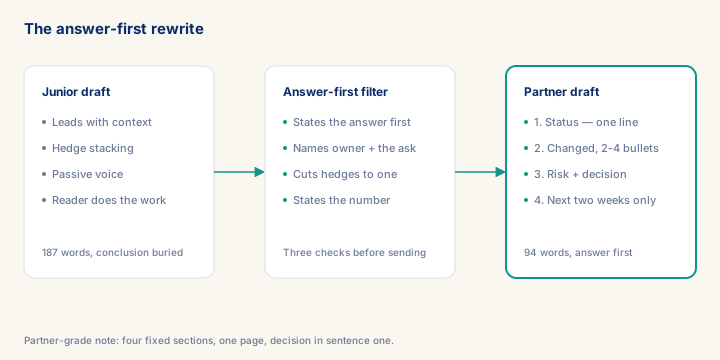
A client forms a judgment about your seniority within the first two paragraphs you write — and that judgment rarely reverses. This module replaces context-first, hedge-stacked drafting with the answer-first structure partners default to: the conclusion in sentence one, evidence after. Applied to a real business-case summary, that structure alone cut word count by half (187 to 94 words) while roughly doubling the decision-relevant content per sentence. In EMEA SAP analytics, consultants billing near EUR 1,200/day are not necessarily stronger analysts than those at EUR 700/day — they consistently write this way.
What you will learn
- Rewrite any executive update using answer-first structure so the key message lands in the first sentence
- Identify and cut the three most common junior writing patterns — context-first framing, hedge stacking, and passive voice — from your own drafts
- Construct a one-page project status note that a C-suite reader can act on in under 90 seconds
- Apply the partner-grade revision checklist to a real deliverable before your next client submission
Why writing signals seniority faster than any slide
Your writing arrives before you do. In every SAP analytics engagement, the moment a client reads your first project-status email or executive summary, they form a judgment about your seniority level — and that judgment is sticky. A partner at a Big-4 firm once told a delivery team: I can tell within two paragraphs whether someone is ready to be client-facing or not. He was not talking about grammar. He was talking about structure, economy of language, and the courage to lead with a conclusion.
The gap between junior and partner-grade writing in SAP analytics projects is not about vocabulary. Junior consultants have large vocabularies. The gap is architectural. It is about where the conclusion lives, how much hedging precedes any assertion, and whether the reader is forced to do interpretive work that the writer should have done instead.
This module gives you the concrete mechanics to close that gap — not as an abstract style guide, but as a craft you can apply to the next email you send this afternoon.
Prerequisites
- Intermediate hands-on experience on SAP analytics projects
- Review core concepts first: C083, C079, C058
Outcomes
- Work through a realistic scenario: A European industrial manufacturer's BW-on-HANA-to-SAP-Analytics-Cloud migration is two weeks behind on data integration and entering its most politically sensitive phase.
- Recognize and avoid the anti-pattern: Context-first narrative — The reader reaches the actual status or ask after several paragraphs of scene-setting, and busy executives stop reading before they get there.
- Apply the module's core decision: How to open a status update or executive summary — choose Lead with the conclusion — status, number, or decision needed — in sentence one; move context and methodology after.
- Track mastery with the KPI: Answer-first compliance (target: The conclusion — status, number, or decision needed — appears in the first sentence of every executive update).
Full module available to members. The full module adds: the decision framework · the end-to-end scenario walkthrough · the KPI scorecard · the anti-patterns · the knowledge check · the diagrams.