Escalations: Raising a Flag Without Burning the House
As of 2026-10-10
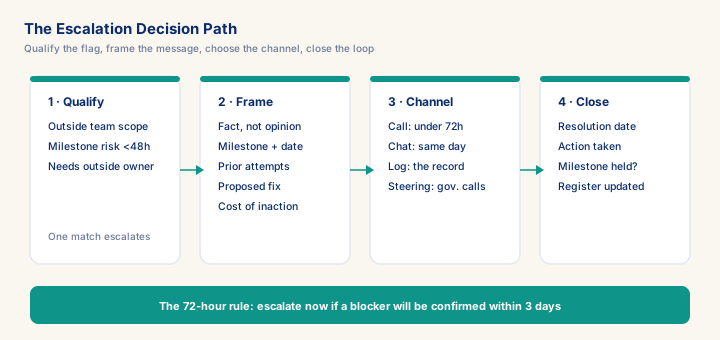
Escalation timing is a solvable design problem, not a personality trait: the same blocker costs a two-day mitigation in week two and a scope-renegotiation crisis in week eight. The dividing line is the 72-hour rule — if a risk will become a confirmed blocker within three days and the team has not cleared it, escalate before the next steering committee, not after. This module gives consultants the three-criteria test for what actually qualifies as an escalation, the five-component message structure that turns a blocker into an actionable ask, and the channel map that matches urgency to medium. Sponsors who never see a consultant let a problem drift are the ones who call that consultant first for the next mandate — the escalation discipline taught here is a direct input to reference quality and day-rate defensibility, not a soft-skill add-on.
What you will learn
- Apply the three-criteria test to distinguish genuine escalation triggers from normal delivery uncertainty, avoiding both under-escalation and erosion of escalation signal quality
- Construct a five-component escalation message (fact, milestone impact, prior attempts, proposed resolution, inaction cost) appropriate for verbal or written delivery to a project sponsor
- Select the correct escalation channel based on decision urgency and documentation requirements, and follow up with a written record regardless of how the initial escalation was made
- Brief affected parties before an escalation lands, close every escalation formally in the project log, and update the risk register to complete the accountability chain
Why Escalation Fails Before It Starts
Most escalations on SAP analytics projects fail not because the problem was wrong, but because the consultant waited too long, framed it wrong, or chose the wrong channel. The blocker that would have been a two-day mitigation in week two becomes a scope renegotiation crisis in week eight. By then the stakes are higher, the relationships are under strain, and the escalation looks like a complaint rather than a risk management act.
Understanding the mechanics of escalation—when to move, how to frame the message, which channel to use, and how to protect the relationship while doing so—is one of the highest-leverage skills a senior SAP analytics consultant develops. It is not a soft skill. It is a project delivery competency with measurable consequences.
Recognising the Flag: What Qualifies as an Escalation
Not every problem is an escalation. Choosing the wrong ones degrades your signal quality with sponsors and management.
Three criteria determine whether something should be escalated versus resolved at the delivery team level:
Prerequisites
- Intermediate hands-on experience on SAP analytics projects
- Review core concepts first: C058, C047, C087
Outcomes
- Work through a realistic scenario: A global industrial-equipment manufacturer's SAP Datasphere and SAC rollout hits a client-side data governance approval stuck for eleven working days.
- Recognize and avoid the anti-pattern: Waiting for the weekly status report to disclose a blocker found days earlier — Three lost response days.
- Apply the module's core decision: Escalate now or hold at team level — choose If any one criterion is met, escalate immediately under the 72-hour rule — do not wait for the next steering committee.
- Track mastery with the KPI: Escalation lead time (target: Risk flagged at least 72 hours before it becomes a confirmed blocker; red flag: Escalation raised only after the milestone has already slipped).
Full module available to members. The full module adds: the decision framework · the end-to-end scenario walkthrough · the KPI scorecard · the anti-patterns · the knowledge check · the diagrams.