Physical Training for Knowledge Workers
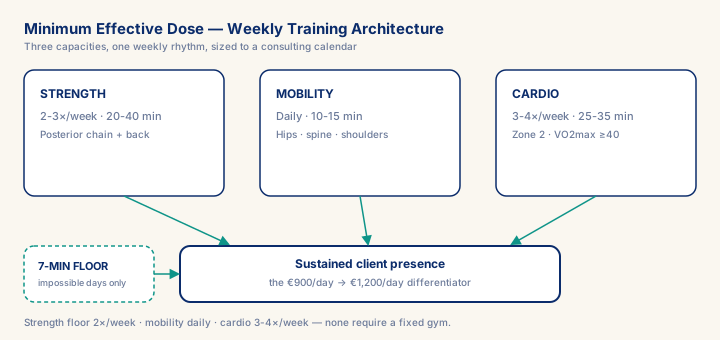
As of 2026-10-04
Desk-bound consulting work produces a predictable physical profile — tight hip flexors, an underloaded posterior chain, thoracic kyphosis — and it responds to a specific, minimum-effective-dose correction rather than a generic fitness plan. The floor: two 20-40 minute full-body strength sessions a week, 10-15 minutes of daily mobility, and three to four zone-2 cardio sessions, none of which require a fixed gym. The number that matters most: strength detraining begins after roughly two weeks of complete inactivity, which is why the 7-minute floor on impossible days — not the perfect programme — is what protects the habit through a go-live sprint. Clients read sustained physical presence, still sharp at 17h00 on day four of a workshop week, as part of what separates a 1,200 €/day consultant from a 900 €/day one.
What you will learn
- Apply the minimum-effective-dose training framework to build strength, mobility and cardiovascular capacity within a time-constrained consulting schedule
- Design a travel-compatible training routine that requires no fixed gym and adapts to hotel rooms, conference venues and project sites
- Recognise the specific physical demands of knowledge work — posture, sustained sitting, cognitive fatigue — and address them with targeted interventions
- Evaluate recovery signals and avoid the overtraining and undertraining failure modes common to irregular schedules
The specific problem of desk-bound, high-cognitive-load work
Knowledge work creates a particular physical profile that is worth naming precisely before discussing training. Long sessions of stationary sitting compress the hip flexors and anterior shoulder capsule, weaken the posterior chain (glutes, hamstrings, mid-back), reduce hip extension mobility, and produce characteristic thoracic kyphosis — the forward-hunched posture that becomes self-reinforcing as the spinal extensors fatigue and lengthen adaptively. Add to this the sympathetic nervous system activation of deadline pressure, client negotiations, and travel disruption, and you have someone who is physically contracted, musculoskeletally imbalanced, and chronically carrying a low-level cortisol load.
The training response to this is not simply "exercise more." It is a specific corrective: prioritise posterior chain strength, hip mobility, thoracic extension, and cardiovascular work that provides a genuine counterweight to the metabolic effects of chronic stress — without adding another layer of stress through overtraining.
This module takes a minimum-effective-dose approach. The question is not "what is the optimal training programme?" but "what is the least you need to do consistently, given your schedule, to maintain functional capacity, physical resilience, and cognitive performance?" The answer is less than most people assume, and more sustainable than most programmes people attempt.
Prerequisites
- Review core concepts first: C047, C100, C097
Outcomes
- Work through a realistic scenario: A consultant starts a six-month S/4HANA finance transformation, four days a week on-site in Frankfurt with a Monday 8h30 stand-up.
- Recognize and avoid the anti-pattern: All-or-nothing periodisation — Three intense weeks before a project, then zero for three months at client, produces a worse outcome — physically and for habit durability.
- Apply the module's core decision: How many strength sessions to commit to per week — choose Two full-body sessions a week (20-40 min, six compound movements) as the permanent floor.
- Track mastery with the KPI: Weekly session adherence (target: ≥ 2 strength sessions + daily mobility, tracked over 4 weeks).
Full module available to members. The full module adds: the decision framework · the end-to-end scenario walkthrough · the KPI scorecard · the anti-patterns · the knowledge check · the diagrams.