
Family & Long-Client Missions
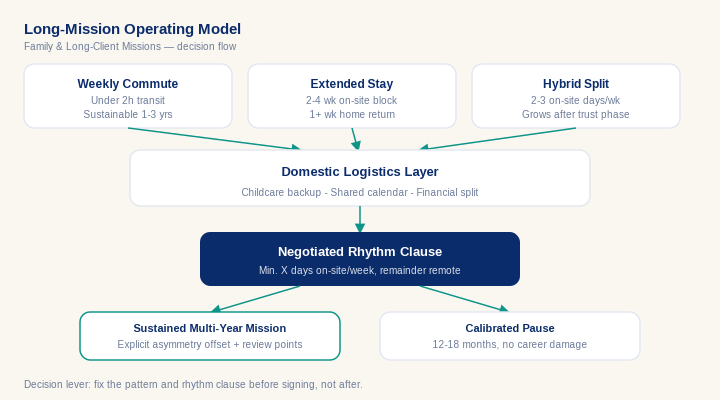
As of 2026-11-07
Family & Long-Client Missions treats a twelve-month contract at a DAX-listed manufacturer and a household in Lyon as one system, not two competing priorities. The real decision is which of three patterns — weekly commute, multi-week extended stay, or a negotiated hybrid split — the engagement can actually sustain, and whether a rhythm clause locks that pattern into the contract before signature. Consultants who negotiate this explicitly typically price a genuine 15-25% premium into international missions once childcare backup, travel, and partner-logistics costs are properly accounted for. The stake is not comfort: it is whether a senior consultant can keep taking DAX-tier and cross-border mandates for another decade without the relationship or the delivery quality breaking first.
What you will learn
- Map the three long-mission patterns (weekly commute, extended stay, hybrid) and assess which each type of engagement realistically supports
- Design a domestic logistics architecture — childcare backup, shared calendar, financial arrangement — that enables sustained absence without overloading a partner
- Negotiate rhythm clauses and on-site/remote splits as professional delivery standards rather than personal constraints
- Identify the family-life phases where long missions are structurally incompatible, and position a calibrated pause without career damage
Scope: a mission in another country is a household and a legal decision
This module covers a freelance SAP analytics consultant who lives in one country and works on a client mission of six to 24 months in another: a Lyon-based consultant on a BW/4HANA migration in Stuttgart, a Zurich-based architect on a Datasphere programme in Munich, a Londoner on a Paris roll-out. The family logistics are the same everywhere; the legal consequences are not. The country comparison below covers France, Germany, Switzerland and the United Kingdom. Belgium, the Netherlands, Austria and Luxembourg follow the same EU social-security rules as France and Germany (European Commission), but their tax rules for travel and lodging are not tabulated here and must be checked locally. Everything is general orientation as of November 2026, not tax or legal advice: confirm with an adviser in both countries before you sign.
The three decisions to take before the contract, in this order:
Prerequisites
- Review core concepts first: C047, C100, C097
Outcomes
- Work through a realistic scenario: A senior SAP analytics consultant based in Lyon is offered a 14-month BW/4HANA-to-Datasphere migration for a German automotive manufacturer, requiring sustained on-site presence in Stuttgart.
- Recognize and avoid the anti-pattern: Accepting the mission before the household conversation — Signing under deadline pressure without agreeing what twelve months of absence means creates resentment no day rate offsets.
- Apply the module's core decision: Which mission pattern to commit to — choose: Weekly commute under a 2-hour TGV or direct-flight radius for missions of one to three years; hybrid (2-3 on-site days/week) once trust is established on analytics-heavy workstreams; avoid: Signing a weekly-commute contract and assuming it will self-convert to hybrid later — it rarely does unless negotiated upfront.
- Track mastery with the KPI: Rhythm clause presence (target: On-site/remote split stated in the contract addendum before signature; red flag: Cadence agreed only verbally with the client — it will not survive a change of client-side sponsor).
Full module with the Consultant plan — €19.90/month. The full module adds: the decision framework · the end-to-end scenario walkthrough · the KPI scorecard · the anti-patterns · the knowledge check · the diagrams.