Meditation Without the Spiritual Baggage
As of 2026-10-03
Attention training is not a wellness perk — it is a specific, replicable cognitive protocol with decades of randomised-trial evidence behind it, and the real decision a consultant faces is which version of the practice to adopt, not whether the evidence is real. The number that matters: a 2018 meta-analysis of 142 randomised trials (Goldberg et al., Psychological Bulletin) found effect sizes on anxiety and stress comparable to first-line pharmacological treatment, produced by 10 minutes of daily focused-attention practice — no app or belief system required. For a senior consultant, the stake is not calm; it is consistency under pressure: the low error rate and stable judgment that justify a top-quartile day rate come from a trainable attentional habit, not from talent alone. Get the protocol wrong — guided apps as a permanent crutch, practice deployed only during a crisis — and the training stimulus disappears; get it right and the adaptation compounds over months.
What you will learn
- Distinguish what the evidence actually supports about attention training from wellness-industry hype, and explain why secular focus practice matters for demanding analytical work
- Apply a 10-minute daily practice drawn from Mindfulness-Based Stress Reduction and cognitive neuroscience — no apps required, no belief system assumed
- Recognise the three most common mistakes consultants make when starting a focus practice and apply the corrections immediately
- Frame a sustainable attention-training habit as a career-performance asset in conversations with clients, colleagues, and in your own rate positioning
What the Research Actually Says — and What It Does Not
Attention training has decades of peer-reviewed evidence behind it. It also has an enormous wellness-industry overhang that conflates two very different things: mindfulness as a contemplative tradition and mindfulness as a secular cognitive intervention. The distinction matters for a consultant who needs to justify a new habit in rational terms.
The evidence base that holds up under scrutiny is specific. Jon Kabat-Zinn's Mindfulness-Based Stress Reduction (MBSR) protocol, developed at the University of Massachusetts Medical School in 1979, has been tested in hundreds of randomised controlled trials. The consistent findings: regular practitioners show measurable reductions in cortisol reactivity, reduced amygdala grey-matter density (associated with lower baseline anxiety), and improved performance on sustained-attention tasks. A 2018 meta-analysis in Clinical Psychology Review (Goldberg et al.) covering 142 randomised samples found mindfulness-based interventions superior to no treatment (d = 0.55) and not different from other evidence-based treatments, with the most consistent support for depression, pain, smoking and addictive disorders.
Prerequisites
- Review core concepts first: C047, C100, C097
Outcomes
- Work through a realistic scenario: A newly-promoted engagement lead is three weeks into a nine-month S/4HANA data-migration programme for a European industrial group — blueprint sessions each morning.
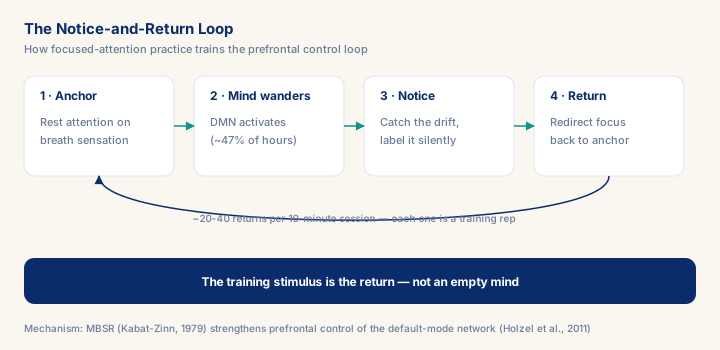
- Recognize and avoid the anti-pattern: Judging a session by how calm it felt — A restless, thought-filled 10 minutes with 30 redirections is a well-run session, not a failed one.
- Apply the module's core decision: Guided app vs. unguided timer — choose Use a guided app (Headspace, Calm, Waking Up) for the first two weeks to learn the structure, then switch to a silent timer.
- Track mastery with the KPI: Session completion rate (target: ≥ 25 of the last 30 days; red flag: < 15/30 — the habit has not survived contact with a normal week yet).
Full module available to members. The full module adds: the decision framework · the end-to-end scenario walkthrough · the KPI scorecard · the anti-patterns · the knowledge check · the diagrams.