Work-Life Boundary Without the Cliché
As of 2026-10-03
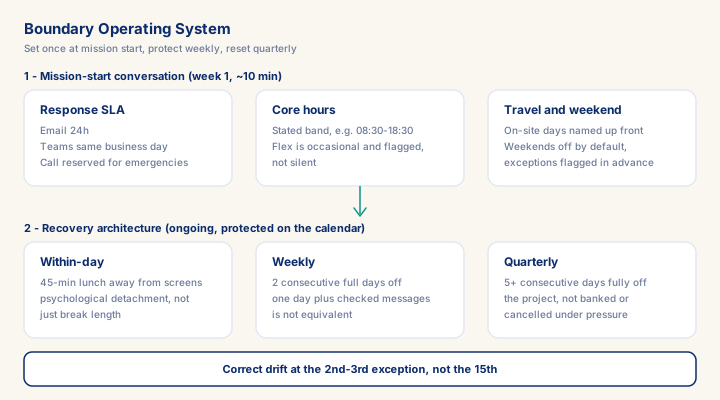
Boundary loss on long missions is not a single decision — it drifts about 5% a week until a senior consultant is running client calls at 20% capacity instead of 80%. The fix is set once, not negotiated on an ongoing basis: three explicit norms (response time by channel, core hours, weekend and travel rules) stated in the first 10 minutes of a mission, before any different expectation forms. A week of six-hour nights produces the cognitive deficit of two full nights without sleep, and consultants under that load consistently believe they are performing normally — so the correction has to land on the second or third drift exception, not the fifteenth. The commercial case: a consultant who protects recovery and states it as a service-level commitment signals seniority a client will pay a premium for; one who says yes to everything delivers variably and erodes the rate case for the whole engagement.
What you will learn
- Map the real availability pressures on a consultant — client expectations, team norms, messaging culture — and distinguish which are negotiable from which are structural constraints
- Apply a concrete boundary-setting protocol at mission start, at mid-mission drift, and during recovery periods — with specific language for each conversation
- Identify the three most common ways boundaries erode silently on long engagements and intervene before they collapse entirely
- Position deliberate recovery and communication discipline as professional markers of seniority, not as limitations, in rate and contract discussions
The Problem Is Not Burnout — It Is Invisible Drift
Most consultants who lose their work-life boundary do not lose it in a single dramatic moment. There is no conversation where a client says "from now on you are on call 24 hours a day" and the consultant agrees. What actually happens is slower and harder to interrupt: invisible drift. The norms of availability shift by 5% per week across a six-month engagement, and by the time the consultant notices, they are answering messages at 23:00, skipping lunch, and taking client calls on weekends, without any single decision having produced that outcome.
The first useful reframe: boundary-setting is not primarily a self-care act. It is a project quality management act. A consultant who is cognitively depleted in month 4 of a 6-month engagement makes worse architectural decisions, misses requirements in workshops, and is less effective in stakeholder negotiations. The client who receives 20% of a senior consultant's capacity through calendar creep receives worse outcomes than the client who receives 80% of a rested senior consultant's capacity for a defined and protected time. This is the framing that works with clients, not the wellness framing.
Prerequisites
- Intermediate hands-on experience on SAP analytics projects
- Review core concepts first: C100, C047, C097
Outcomes
- Work through a realistic scenario: A senior consultant joins a 6-month BW/4HANA-to-Datasphere migration for a European retail group.
- Recognize and avoid the anti-pattern: Apologising for the boundary instead of stating it — "I hope you don't mind, but..." invites negotiation; the client tests the limit instead of respecting it.
- Apply the module's core decision: When to have the boundary conversation — choose Open with the 10-minute norms conversation before the first full project week — response SLA, core hours.
- Track mastery with the KPI: Weekend-message response latency.
Full module available to members. The full module adds: the decision framework · the end-to-end scenario walkthrough · the KPI scorecard · the anti-patterns · the knowledge check · the diagrams.