Master Service Agreements with Enterprises
As of 2026-10-10
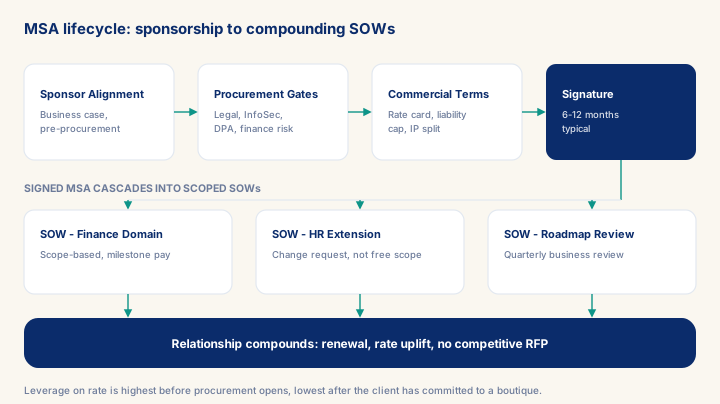
A first Master Service Agreement with a Fortune 500 or STOXX 50 client is the single biggest commercial lever a boutique SAP analytics firm can pull — it turns every future engagement from a multi-month procurement event into a signature exercise. The catch: the process runs six to twelve months through six to eight approval gates, and the terms signed in month one — rate card, liability cap, IP ownership — hold for two to three years. Get the rate card wrong at the junior tier and margin erodes exactly as the engagement scales; get the liability cap wrong and an uninsured claim can end the boutique. This module gives the negotiation sequence, the rate-card math, and the liability and IP language that protect a boutique through the life of the contract — and the discipline that turns one signed MSA into a compounding pipeline of SOWs instead of a single deal.
What you will learn
- Sequence an MSA negotiation from stakeholder sponsorship through procurement qualification to final signature over a realistic 6–12-month timeline
- Construct a rate card that builds in annual uplift, avoids junior-level compression, and survives a 3-year engagement without margin erosion
- Draft SOW scope, inclusion/exclusion lists, milestone payment structures, and change request triggers that enforce commercial boundaries without damaging the client relationship
- Negotiate liability caps and IP ownership provisions that are insurable, commercially rational, and protect the boutique's reusable methodology
What an MSA Actually Does and Why It Takes Six to Twelve Months
A Master Service Agreement with a large enterprise is not a project contract — it is the commercial infrastructure on top of which project contracts are built. The MSA establishes rate cards, liability caps, IP ownership, data protection obligations, payment terms, and the process for raising individual Statements of Work. Once signed, the MSA means every subsequent engagement can be contracted in days rather than months, because the commercial terms do not need to be renegotiated each time.
For a boutique SAP analytics firm, landing a first MSA with a Fortune 500 or STOXX 50 client is a qualitative shift in the commercial relationship. It signals that the enterprise procurement team has run full supplier qualification — financial due diligence, insurance verification, data processing agreements — and concluded that your boutique meets their vendor standards. It also signals that the internal stakeholder who sponsored the relationship had enough credibility to push the engagement through a procurement process that typically has six to eight separate approval gates.
Prerequisites
- Intermediate hands-on experience on SAP analytics projects
- Review core concepts first: C087, C100, C086
Outcomes
- Work through a realistic scenario: A German industrial group's SAP centre of excellence has bought single-SOW engagements from a 12-person Alpine analytics boutique for eighteen months.
- Recognize and avoid the anti-pattern: Signing before an insurance review — The boutique accepts liability obligations its actual professional-indemnity policy does not cover.
- Apply the module's core decision: When to invest in pursuing an enterprise MSA — choose Pursue the MSA once a sponsor has asked for a second engagement and can name the procurement contact.
- Track mastery with the KPI: Time to MSA signature (target: Under 9 months from sponsor case to countersignature; red flag: Over 12 months with no single identifiable blocking gate).
Full module available to members. The full module adds: the decision framework · the end-to-end scenario walkthrough · the KPI scorecard · the anti-patterns · the knowledge check · the diagrams.