
Sleep: The Most Under-Valued Performance Lever
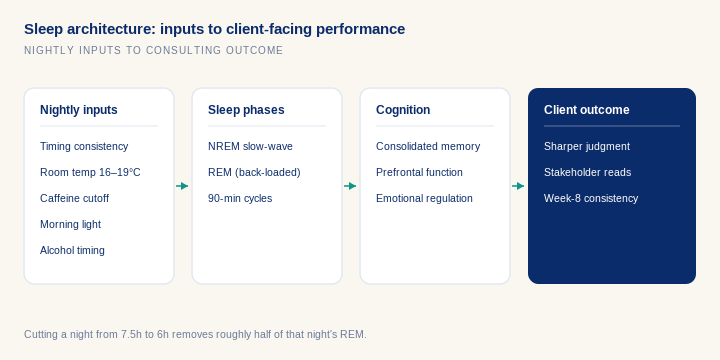
As of 2026-11-07
Sleep is not wellness: it is the input that decides whether judgment holds across an eight-week delivery. In a controlled experiment, 14 days at 6 hours in bed produced cognitive deficits equivalent to up to 2 nights of total sleep deprivation, while participants rated their own sleepiness as barely changed (Van Dongen et al., 2003). This module turns that finding into a planning method: count nights below 7 hours, test caffeine timing and alcohol effects against your own log for 4 weeks, and write a review window into the contract so that AI-generated drafts are not checked in the hours that used to be sleep. The stake is whether you still deliver senior-grade thinking in week eight, not just week two. It gives no medical advice.
What you will learn
- Understand the neurological mechanisms behind sleep-dependent memory consolidation and decision-making degradation
- Identify which sleep deprivation symptoms most directly impair consulting performance and client interactions
- Apply evidence-based sleep hygiene practices within the constraints of project travel and deadline pressure
- Build a personal sleep protocol that sustains cognitive sharpness across multi-week delivery engagements
Scope: what this module covers and the rest rules you can cite
This module treats sleep as delivery infrastructure for SAP consultants: what controlled studies show about restricted sleep, what that means for week eight of a programme, and how to protect sleep through travel, client dinners and AI-assisted evening reviews. It gives no medical advice. Where a health claim appears, it comes from the sources linked in the same section; persistent sleep problems belong with a doctor, not with a module. Countries with sourced rest rules: the EU level, Germany, the United Kingdom and France (partly). Switzerland is not covered here: read the Federal Act on Work (ArG) on fedlex.admin.ch and your contract directly. Sources checked on 2026-11-07.
The 5 rows below protect employees. Whether a freelancer counts as a "worker" depends on national law, which is why the travel chapter puts the rest window into the contract.
Prerequisites
- Review core concepts first: C095, C047, C100
Outcomes
- Work through a realistic scenario: A senior SAP analytics consultant is three weeks into an eight-week S/4HANA Group Reporting rollout for a European automotive supplier — five client workshops a week, two hotel nights, and a steering committee that has started asking harder questions.
- Recognize and avoid the anti-pattern: Treating the weekend as the recovery mechanism — No source checked for this module shows that one or two long nights erase a week of short nights; plan sleep across the engagement, not only at its end.
- Apply the module's core decision: How to respond when a delivery week compresses your sleep window — choose: Protect the sleep window and cut scope or working hours elsewhere — a rested consultant producing less beats an exhausted one producing more; avoid: Treating sleep as the flexible variable because it is the one nobody sees on a timesheet.
- Track mastery with the KPI: Nights below 7 hours per week (target: <= 2 nights/week during active delivery; red flag: >= 4 nights/week below 6 hours for two consecutive weeks: in Van Dongen 2003, 14 nights at 6 h produced deficits equal to up to 2 nights of total sleep deprivation).
Full module with the Consultant plan — €19.90/month. The full module adds: the decision framework · the end-to-end scenario walkthrough · the KPI scorecard · the anti-patterns · the knowledge check · the diagrams.