
M&A: Acquiring a Small Practice
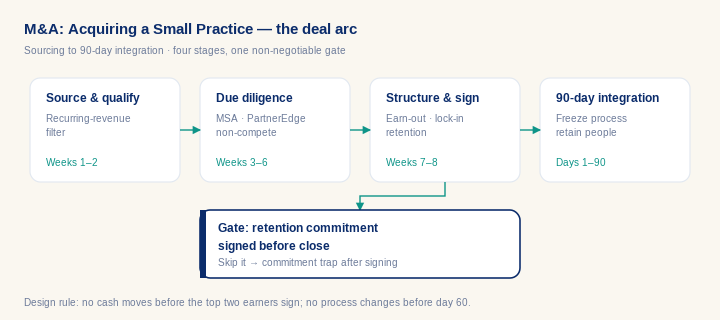
As of 2026-11-07
Acquiring a small SAP analytics practice looks like the fastest way to buy scarce Datasphere and BW/4HANA talent — but 40–60% of small professional-services acquisitions fail to retain key people within 24 months, and the failure is almost never the financial model. The valuation question is not the multiple (0.5×–1.5× revenue, or 3×–6× EBITDA in EMEA) but whether the client base survives the founder's exit: revenue concentrated on one client and one relationship trades at the bottom of the range regardless of profitability. The decision that actually protects the deal is signed before close — a retention commitment from the target's top two earners — and the decision that protects it after close is a 60-day freeze on billing, HR, and reporting changes for the acquired team. Get the 90-day integration right and the combined firm can defend, not cut, its day rate on every renewal that follows.
What you will learn
- Source small SAP analytics practice acquisition targets through ecosystem channels and apply the recurring-revenue filter before investing due diligence time
- Apply realistic EMEA professional-services valuation multiples (0.5×–1.5× revenue, 3×–6× EBITDA) and understand what drives discount vs premium
- Structure due diligence across the four non-negotiable areas: contract portability, SAP partner agreement transfer, non-compete enforceability, and IP technical debt
- Build a 90-day integration plan centred on people retention and design earn-out structures that do not create perverse billability incentives
Why Small SAP Practices Get Acquired — and Why Most Acquirers Regret It
The strategic case for acquiring a small SAP analytics practice is straightforward: you buy a client list, a team with existing SAP certifications, and a book of recurring managed-service or project revenue. In EMEA, where senior Datasphere or BW/4HANA talent is scarce, acquiring rather than hiring is often the faster path to capability. But small professional-services acquisitions fail on people far more often than on numbers: Bain's 2026 software M&A report names talent retention as a success factor and notes that top performers are easily poached and that money alone does not retain them. The failure mode is almost never the financial model; it is almost always the people.
Prerequisites
- Intermediate hands-on experience on SAP analytics projects
- Review core concepts first: C087, C083, C074
Outcomes
- Work through a realistic scenario: A 12-consultant SAP analytics boutique in Paris is evaluating the acquisition of a 5-person BW/4HANA practice in Lyon whose founder wants to retire within a year and whose largest client is a mid-cap industrial group on a three-year managed-service contract.
- Recognize and avoid the anti-pattern: Closing without a signed retention commitment from the target's top two earners — Once the deal is signed, the pressure to close removes the leverage to negotiate retention terms — the commitment trap.
- Apply the module's core decision: How to size the offer — choose: Anchor on 0.5×–1.5× revenue (3×–6× EBITDA in EMEA) and push toward the low end whenever founder-sourced revenue exceeds half of turnover; avoid: Letting a seller's broker justify the price with SaaS-style multiples — they do not apply to a people-dependent professional-services book.
- Track mastery with the KPI: 12-month key-person retention (target: 100% of the consultants named in the pre-close retention commitment still billing at month 12; red flag: Any named consultant departs within 12 months without a documented trigger event).
Full module with the Consultant plan — €19.90/month. The full module adds: the decision framework · the end-to-end scenario walkthrough · the KPI scorecard · the anti-patterns · the knowledge check · the diagrams.