Data Access Controls (DAC)
As of 2026-10-10
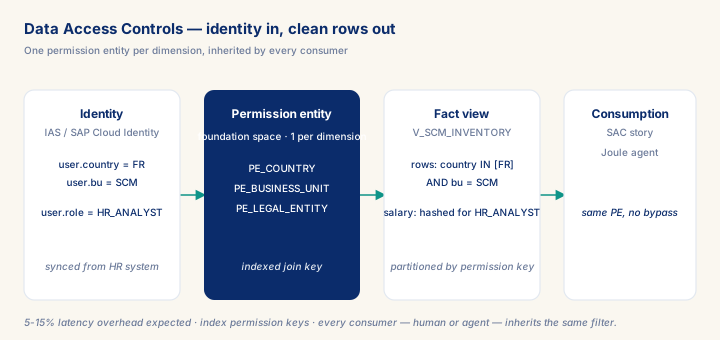
DAC = row + column security in Datasphere, mandatory for GDPR Art. 5/9 + EU AI Act Art. 10. Senior pattern: 1 permission entity per dimension in foundation space (PE_COUNTRY, PE_BU, PE_ENTITY), inherited across domain models. User attributes flow from IAS, not maintained in Datasphere. Index permission keys; expect 5-15 % latency overhead. Skip DAC and face 200-800 person-day remediation per high-risk system.
What you will learn
- Work through a realistic scenario: European pharma, GDPR Art. 9 special-category data (employee health), 18-country presence. CISO requires DAC sign-off before consumption layer goes live.
- Recognize and avoid the anti-pattern: DAC added in week 8 as compliance afterthought — Refactor cost ~3× build cost; sponsor confidence collapses.
- Apply the module's core decision: Row vs column DAC — choose Row for entity/territory restriction; column for PII/salary/health masking, not Either-or thinking — most engagements need both.
- Track mastery with the KPI: Art. 9 column coverage (target: 100 % under DAC; red flag: Any uncovered Art. 9 column).
Module overview
Data Access Controls, universally shortened to DAC, are the row-level and column-level security layer that sits inside SAP Datasphere between the modelled data and the person or process consuming it. Without DAC, every analytic model in a space is "all data for everyone with access to the space" — which is not a theoretical risk, it is a GDPR Article 5 data-minimization violation, an internal-audit finding waiting to happen, and in practice the single most common reason a well-built analytics foundation gets blocked at go-live by a CISO or Data Protection Officer who finally reads the design document. A senior consultant designs DAC alongside the space topology in week one of a Datasphere engagement, as part of the semantic and security architecture — not as a bolt-on remediation in week eight once the sponsor's security team has already raised the flag. That sequencing difference is one of the clearest signals of seniority in a Datasphere design review.
Prerequisites
- Review core concepts first: C008, C006, C004
Outcomes
- Work through a realistic scenario: European pharma, GDPR Art. 9 special-category data (employee health), 18-country presence. CISO requires DAC sign-off before consumption layer goes live.
- Recognize and avoid the anti-pattern: DAC added in week 8 as compliance afterthought — Refactor cost ~3× build cost; sponsor confidence collapses.
- Apply the module's core decision: Row vs column DAC — choose Row for entity/territory restriction; column for PII/salary/health masking, not Either-or thinking — most engagements need both.
- Track mastery with the KPI: Art. 9 column coverage (target: 100 % under DAC; red flag: Any uncovered Art. 9 column).
Full module available to members. The full module adds: the decision framework · the end-to-end scenario walkthrough · the KPI scorecard · the anti-patterns · the code blocks · the knowledge check · the diagrams.