Currency Conversion & Units
As of 2026-10-04
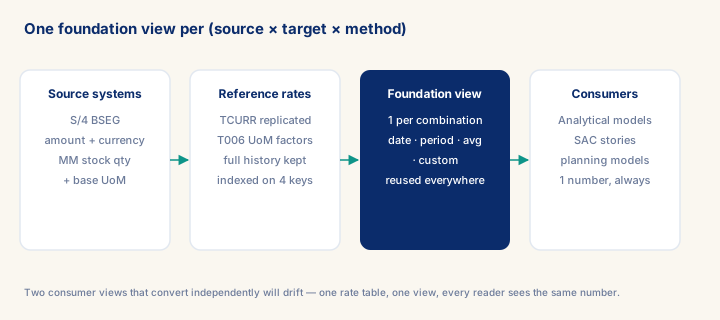
4 conversion methods (date · period-end · average · custom). Senior pattern: 1 conversion view per (source × target × method) in foundation space, reused everywhere. NEVER hardcode rates. Read from TCURR-replicated table. Index rate table; partition fact by date if conversion is dominant cost.
What you will learn
- Work through a realistic scenario: Multi-entity group, 14 currencies, IFRS reporting, monthly consolidation in EUR.
- Recognize and avoid the anti-pattern: Hardcoded rates — CFO discovers at year-end, restatement risk.
- Apply the module's core decision: Conversion method — choose Date-based for revenue recognition; period-end for balance sheet; average for income statement consolidation; custom for budgeting.
- Track mastery with the KPI: Conversion view count (target: 1 per (source × target × method); red flag: Duplicates = drift risk).
Module overview
Currency conversion = the operation that turns "€5M French sales + £3M UK sales + $7M US sales" into "consolidated EUR revenue". Get this wrong and the CFO finds out at month-end close — every time. Datasphere supports 4 conversion methods; senior consultants pick per use case and document.
The 4 methods.
- Date-based rate — convert at the transaction's posting date (revenue recognition standard, IFRS / US GAAP).
- Period-end rate — convert at month-end (balance sheet standard).
- Average rate — month/quarter/year average (income statement consolidation).
- Custom rate — corporate plan rate, historical rate, hedged rate (planning + budgeting).
The senior pattern. Define ONE conversion view per (source × target × method) combination in the foundation space. Reuse across all consumers. Never let two consumer views convert independently — drift WILL happen.
Unit conversion follows the same logic: ONE conversion view per (unit × method). UoM tables in S/4HANA (T006) are authoritative; reflect them in the foundation space, not in each consumer.
Prerequisites
- Review core concepts first: C008, C012, C006
Outcomes
- Work through a realistic scenario: Multi-entity group, 14 currencies, IFRS reporting, monthly consolidation in EUR.
- Recognize and avoid the anti-pattern: Hardcoded rates — CFO discovers at year-end, restatement risk.
- Apply the module's core decision: Conversion method — choose Date-based for revenue recognition; period-end for balance sheet; average for income statement consolidation; custom for budgeting.
- Track mastery with the KPI: Conversion view count (target: 1 per (source × target × method); red flag: Duplicates = drift risk).
Full module available to members. The full module adds: the decision framework · the end-to-end scenario walkthrough · the KPI scorecard · the anti-patterns · the code blocks · the knowledge check · the diagrams.