SQL Editor & Stored Procedures
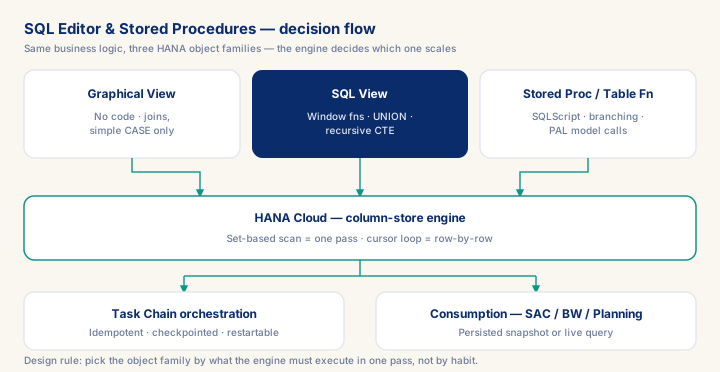
As of 2026-10-10
A SQL view or a stored procedure is the tool an architect reaches for the moment a graphical view builder cannot express the logic — window functions, recursive hierarchies, transactional ETL with rollback. The decision that separates senior from junior is not whether to write SQL, but which HANA object family to write it in: a badly-chosen cursor loop turns a 100,000-account load into 100,000 round-trips, and a stored procedure without checkpoint logic turns a 15-minute failure into a full reprocessing incident visible to the client's finance team. Get the SQL-view-vs-procedure-vs-table-function call right and a transformation scales to a billion-row fact table; get it wrong and it saturates a shared production HANA Cloud tenant during a go-live week. This module is the operating discipline for that call — not a syntax tour.
What you will learn
- Work through a realistic scenario: A European industrial-equipment manufacturer's finance team needs multi-currency, multi-ledger P&L reporting in Datasphere.
- Recognize and avoid the anti-pattern: Cursor-per-key loop instead of a set-based JOIN — 100,000 accounts become 100,000 round-trips.
- Apply the module's core decision: SQL view vs graphical view vs stored procedure — choose SQL view for window functions, set operations, and recursive CTEs that stay read-only.
- Track mastery with the KPI: Query plan quality (target: 0 full COLUMN TABLE SCAN on tables >10M rows without a filtering predicate).
SQL Editor & Stored Procedures in Datasphere and HANA Cloud
Datasphere's SQL editor and stored procedures are the escape hatch for logic the graphical view builder cannot express — and for senior architects they are the primary tool for performance-critical transformation, complex business rules, and reusable procedural logic. Two object families matter and they are not the same thing: SQL views (declarative SELECT-based, participates in the Datasphere semantic model) and SQLScript procedures / table functions (imperative or set-based, invoked from Data Flows or Task Chains). Understanding when each applies — and the HANA Cloud execution model behind them — is the difference between transformations that scale to billions of rows and those that collapse under load.
Prerequisites
- Intermediate hands-on experience on SAP analytics projects
- Review core concepts first: C008, C004, C006
Outcomes
- Work through a realistic scenario: A European industrial-equipment manufacturer's finance team needs multi-currency, multi-ledger P&L reporting in Datasphere.
- Recognize and avoid the anti-pattern: Cursor-per-key loop instead of a set-based JOIN — 100,000 accounts become 100,000 round-trips.
- Apply the module's core decision: SQL view vs graphical view vs stored procedure — choose SQL view for window functions, set operations, and recursive CTEs that stay read-only.
- Track mastery with the KPI: Query plan quality (target: 0 full COLUMN TABLE SCAN on tables >10M rows without a filtering predicate).
Full module available to members. The full module adds: the decision framework · the end-to-end scenario walkthrough · the KPI scorecard · the anti-patterns · the code blocks · the knowledge check · the diagrams.