Hierarchies in Datasphere
As of 2026-10-03
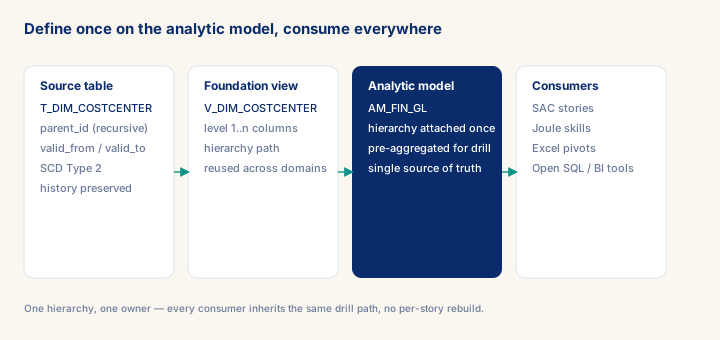
2 flavours: parent-child (variable depth, e.g. cost center) and level-based (fixed depth, e.g. fiscal time). Senior pattern: define on analytic model not view, single source consumed everywhere. Time hierarchy = V_DIM_CALENDAR in foundation. Cost center = SCD Type 2 (history preserved). Use server-side hierarchy pre-aggregation for SAC drill perf.
What you will learn
- Choose between parent-child and level-based hierarchy design for a given business dimension
- Model a Type-2 SCD hierarchy that survives org reorgs without breaking historical reports
- Define hierarchies once on the analytic model so SAC, Joule, and Excel consumers stay in sync
- Position hierarchy design as a rate-relevant skill in a client conversation
Module overview
Hierarchies = the structure that turns flat dim tables into "drill from Group → Region → Country → Cost Center" navigation. Without proper hierarchies, every SAC story rebuilds them ad-hoc; with them, every story inherits Group standard.
Two flavours.
- Parent-child hierarchies — variable depth (e.g. cost center hierarchy with 3-12 levels). Modeled as recursive structure with parent id pointing within the same table.
- Level-based hierarchies — fixed depth (e.g. fiscal year > quarter > month). Modeled with explicit level columns.
Senior pattern. Define hierarchies on the analytic model, not on the view. The analytic model is the trust layer; SAC stories, Joule skills, and Excel pivots all read it. Define ONCE; consume everywhere.
Time hierarchies are the ones every engagement uses. Build the V_DIM_CALENDAR in the foundation space with: fiscal year, fiscal quarter, fiscal month, fiscal week, calendar year, calendar month, calendar quarter, period-to-date flags. Reuse across all domains.
Cost center hierarchies drift constantly (reorgs). Build a Type-2 SCD pattern: keep history, query at as-of-date. Junior consultants overwrite; the next reorg breaks every historical report.
Prerequisites
- Review core concepts first: C008, C006, C005
Outcomes
- Work through a realistic scenario: Industrial group, 12 entities, fiscal year != calendar year, cost center hierarchy 8-level, monthly reorgs.
- Recognize and avoid the anti-pattern: Type 1 SCD on org dim — Reorg breaks all historical reports.
- Apply the module's core decision: Parent-child vs level-based — choose Parent-child for org/cost center; level-based for time/product, not Forcing level-based on variable depth (lossy).
- Track mastery with the KPI: Hierarchy reuse (target: 1 definition per dim, ≥ 3 consumers; red flag: Per-consumer redefinition).
Full module available to members. The full module adds: the decision framework · the end-to-end scenario walkthrough · the KPI scorecard · the anti-patterns · the code blocks · the knowledge check · the diagrams.