Tenant Administration
As of 2026-10-10
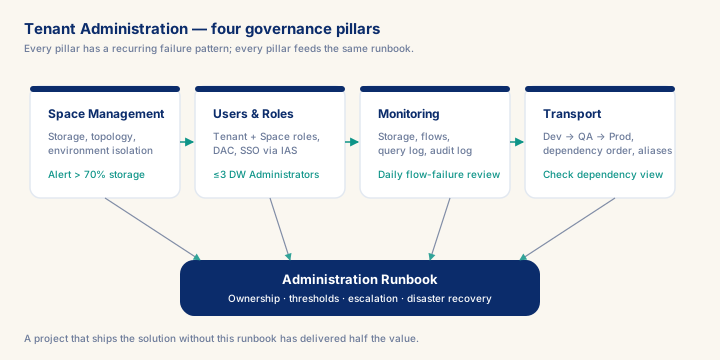
Tenant Administration decides whether a Datasphere platform survives its first year or collapses under storage overruns, broken row-level security, and botched transports. The senior calls that matter: cap DW Administrator assignments at three (one primary, two deputies), trigger a capacity review the moment any Space passes 70% storage, and never place a Data Access Control on a Transactional Table — each is a documented failure pattern that costs projects weeks of remediation, not hours. Consultants who deliver the Administration Runbook alongside the technical build, not after it, are the ones customers keep on retainer past go-live — a tenant that degrades within six months reflects on whoever designed it. This module hands you the four-pillar operating model (Space, roles, monitoring, transport) as a client-ready deliverable, not a feature tour.
What you will learn
- Work through a realistic scenario: A DACH industrial manufacturer is consolidating six legacy BW/4HANA systems into a single shared Datasphere tenant serving Finance, Supply Chain, and HR, with Dev, QA.
- Recognize and avoid the anti-pattern: DW Administrator over-assignment — More people than necessary can delete a Space or reallocate tenant storage — an SAP_ALL-equivalent blast radius nobody is tracking.
- Apply the module's core decision: Space topology pattern — choose Layer-based Spaces (Landing — Harmonisation — Consumption) for a centralised platform team.
- Track mastery with the KPI: Space storage headroom (target: All Spaces below 70% of their storage allocation; red flag: Any Space above 80% with no capacity request already in flight).
Why Tenant Administration Is a Senior Competency
Most SAP Datasphere implementations fail not because of a bad data model but because of a poorly governed tenant. Inadequate Space sizing causes planning submission errors six months after go-live. Uncontrolled role assignments let analysts bypass row-level security. Transport mismanagement overwrites production content with DEV artefacts. Tenant administration is the discipline that prevents all of these — and it belongs on the senior architect's agenda from day one, not delegated entirely to Basis.
What follows: the four pillars of Datasphere tenant administration: Space management, user and role governance, monitoring and sizing, and transport. Each pillar has recurring failure patterns that cost projects weeks of remediation. Know them before you start.
Space Management: The Fundamental Unit of Governance
A Datasphere Space is a self-contained governance container: it has its own storage allocation (disk + memory), its own set of authorised users and roles, its own connections to source systems, and its own set of artefacts (tables, views, data flows, analytical datasets). Crucially, data from one Space is not automatically visible to another — cross-Space sharing is explicit, governed by the Space owner, and audited.
Prerequisites
- Intermediate hands-on experience on SAP analytics projects
- Review core concepts first: C008, C006, C004
Outcomes
- Work through a realistic scenario: A DACH industrial manufacturer is consolidating six legacy BW/4HANA systems into a single shared Datasphere tenant serving Finance, Supply Chain, and HR, with Dev, QA.
- Recognize and avoid the anti-pattern: DW Administrator over-assignment — More people than necessary can delete a Space or reallocate tenant storage — an SAP_ALL-equivalent blast radius nobody is tracking.
- Apply the module's core decision: Space topology pattern — choose Layer-based Spaces (Landing — Harmonisation — Consumption) for a centralised platform team.
- Track mastery with the KPI: Space storage headroom (target: All Spaces below 70% of their storage allocation; red flag: Any Space above 80% with no capacity request already in flight).
Full module available to members. The full module adds: the decision framework · the end-to-end scenario walkthrough · the KPI scorecard · the anti-patterns · the code blocks · the knowledge check · the diagrams.