Analytical Models & Consumption
As of 2026-10-06
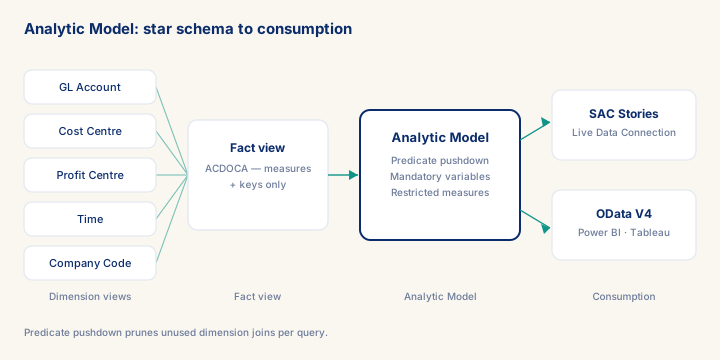
Analytical Models & Consumption decides whether a Datasphere/SAC semantic layer scales past prototype or collapses under production load. The single highest-leverage architecture choice is star schema versus flat view: a narrow fact view with associated dimension views lets Datasphere prune joins per query, while a one-wide-view shortcut works in a demo and fails once fact tables cross 10M rows. Two guardrails separate a senior build from a junior one — a mandatory filter variable on any model backed by more than 50M rows (the leading cause of SAC story timeouts in production), and calculated ratio measures defined at the analytic-model layer, never as row-level view expressions, so percentages aggregate correctly at every drill level. Ship this pattern and a recurring production incident becomes a one-line design-review comment before go-live.
What you will learn
- Build a multi-dimensional analytical model in SAP Analytics Cloud — defining dimensions, measures, calculated measures, and row-level data access controls — and verify that key figures reconcile against the source system
- Diagnose a semantic inconsistency in a published analytical model (filter-context-dependent calculation result) and resolve it at the model layer with documented rationale
- Configure a consumption view from an analytical model in a story — selecting the right chart type, applying hierarchy navigation, and validating that filter propagation matches the intended business logic
- Produce a model-definition handover note that lets another consultant reproduce the semantic layer without a verbal briefing
Analytical Models in SAP Analytics Cloud and Datasphere: Architecture and Consumption
The analytical model is the semantic layer object that sits between raw data and business consumers. In the SAP analytics stack it appears in two distinct forms — the SAP Analytics Cloud live model (connecting directly to HANA, Datasphere, or BW views) and the Datasphere analytic model (a modelled semantic layer defined inside Datasphere and exposed to SAC, third-party BI, and OData consumers). Architects who conflate these two or who default to a 'just build a view' approach without considering the analytic model's optimisation capabilities routinely deliver platforms that perform poorly at scale and are unmaintainable as business requirements evolve.
The Datasphere Analytic Model: Architecture
A Datasphere analytic model is a design-time artefact that references one or more underlying data layer objects — graphical views, SQL views, local tables, or remote tables — and adds a semantic, query-optimised layer on top. It is the recommended consumption object for SAC stories, SAC planning models, and OData API consumers.
Core components of an analytic model:
Prerequisites
- Review core concepts first: C019, C008, C083
Outcomes
- Work through a realistic scenario: A European retail group (15 company codes) needs an hourly-refreshed P&L SAC story with GL-account and profit-centre drill-down.
- Recognize and avoid the anti-pattern: Building the analytic model on one unoptimised flat view — Works in the prototype; every query scans the full row width once the fact table passes roughly 10M rows.
- Apply the module's core decision: Analytic model, plain view, or BW CompositeProvider for this consumption need.
- Track mastery with the KPI: SAC story initial load time (target: < 5 seconds for a full fiscal year range; red flag: > 10 seconds — inspect the join plan for unindexed columns before adding hardware).
Full module available to members. The full module adds: the decision framework · the end-to-end scenario walkthrough · the KPI scorecard · the anti-patterns · the code blocks · the knowledge check · the diagrams.