SAC Planning Fundamentals
As of 2026-10-09
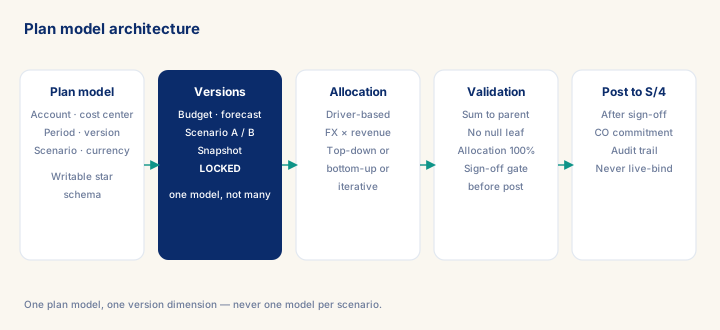
Plan models are governed first-class artefacts, not Excel-replacement spreadsheets — the version dimension (budget · forecast · scenario · locked snapshot) is where most builds go wrong. Three patterns — top-down, bottom-up, iterative reconciliation — the right default tracks planning culture, not tool capability. Senior pattern: version-locked snapshots, a signed sign-off audit trail, and S/4 commitments posted only after sign-off; live-binding turns every keystroke into a CO posting. The day-rate premium sits in that last decision: a junior wires write-back to a flat table, a senior designs the audit trail that survives the finance controller's questions eighteen months later.
What you will learn
- Design a plan model as a governed star schema with write-back — dimensions, version taxonomy, and validation rules, not a rebuilt corporate spreadsheet.
- Choose the right planning pattern — top-down, bottom-up, or iterative reconciliation — for the client's actual planning culture, and defend the choice against two rejected alternatives.
- Build a sign-off workflow that gates S/4 commitment posting, with an audit trail and a documented snapshot retention policy.
- Name the version-taxonomy decision that separates a junior SAC configurator from a premium-rate planning architect.
Module overview
SAC Planning = the closed-loop layer where actuals from Datasphere meet plan/forecast/budget written-back by business users. The senior pattern: plan models are governed first-class artefacts, not Excel-replacement spreadsheets. Junior failure: rebuild the corporate spreadsheet in SAC. Senior craft: design plan models with version control, allocation logic, currency conversion, and integration to S/4 commitment posting.
The plan model = star schema with write-back. Like an analytic model, but writable. Dimensions (account, cost center, period, version, scenario) + measures (planned amount, committed amount, actuals, variance). The version dimension is the one juniors get wrong: budgets, forecasts, scenarios, snapshots — all are versions in one model, not separate models.
The 3 plan model patterns.
- Top-down planning — Group sets a target, allocates down via driver-based logic (e.g. revenue × 4.2 % FX = headcount budget per region).
- Bottom-up planning — local managers enter their plan, system aggregates, GAP shown vs Group target.
- Iterative reconciliation — top-down + bottom-up running together, gap-closing meeting cadence.
Prerequisites
- Review core concepts first: C020, C019, C017
Outcomes
- Design a governed plan model — star schema with write-back — instead of an Excel-replacement spreadsheet.
- Select and defend a planning pattern (top-down, bottom-up, or iterative reconciliation) against the client's actual planning culture.
- Apply the module's core decision: Top-down vs bottom-up vs iterative — choose Iterative for high-stakes annual; bottom-up for bottoms-up; top-down for fast targets, not Mismatch with org culture.
- Track mastery with the KPI: Plan model count per cycle (target: 1 per planning domain; red flag: > 3 = drift risk).
Full module available to members. The full module adds: the decision framework · the end-to-end scenario walkthrough · the KPI scorecard · the anti-patterns · the code blocks · the knowledge check · the diagrams.
Guides that answer with this page
These guides cite this page as one of the sources their answer rests on.