SAP Knowledge Graph & the HANA Cloud Knowledge Graph Engine
As of 2026-10-10
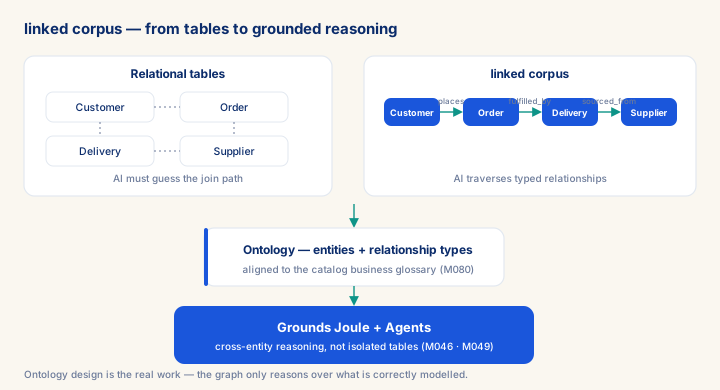
SAP Knowledge Graph is the core of the SAP Business AI Platform announced at Sapphire 2026: it gives Joule and AI agents a structured map of business entities, processes and relationships across the customer's SAP landscape (press coverage of the SAP–Claude partnership cites a S/4HANA graph spanning roughly 452,000 ABAP tables, 80,000 CDS views and 7.3 million fields — a scale SAP itself has not published on a primary page, so treat the figure as directionally illustrative rather than an SAP-stated number). Underneath sits the SAP HANA Cloud knowledge graph engine, GA since Q1 2025: an RDF triple store queried in SPARQL via SYS.SPARQL_EXECUTE, interoperable with SQL through SPARQL_TABLE, and since TechEd 2025 able to generate graphs from HANA Cloud metadata. The consultant does not redesign SAP's ontology; the work is scope and roles, glossary alignment, customer-specific extensions, validation and edge-level security. "Knowledge graph" is not an SAP product name.
What you will learn
- Distinguish SAP Knowledge Graph (the solution), the SAP HANA Cloud knowledge graph engine and a custom customer graph, and position each in one sentence.
- Load RDF triples into SAP HANA Cloud, run a multi-hop SPARQL query through SYS.SPARQL_EXECUTE and join the result with relational data via SPARQL_TABLE.
- Design and validate an ontology extension for one customer-specific object against the governed business glossary, using at least five validation queries with known answers.
- Decide, for a given use case, whether a knowledge graph, a dimensional model or a released API is the right tool, and document the rationale.
- Specify edge-level security for sensitive relationships and the ownership model that keeps the graph aligned with its sources.
Module overview
SAP Knowledge Graph is SAP's answer to a problem every enterprise AI project hits sooner or later: a language model can read a table, but it does not know that a sales order belongs to a customer, is fulfilled by a delivery, is billed through an invoice and depends on a material that a delayed supplier provides. Those relationships live in SAP's data model — in hundreds of thousands of tables and tens of thousands of CDS views — and SAP has decided to make them explicit, machine-readable and available to Joule and to AI agents. This module teaches what the product is, what runs underneath it, what you configure versus what SAP delivers, and how to practise with the SAP HANA Cloud knowledge graph engine yourself.
Prerequisites
- Working knowledge of SAP data models (CDS views, business objects) and SQL
- Review core concepts first: C028, C027, C008
- Recommended: module M031 (BDC Introduction & Architecture)
Outcomes
- Explain SAP Knowledge Graph's role in the SAP Business AI Platform to a sponsor without graph-database jargon.
- Operate the HANA Cloud knowledge graph engine: enable it, load triples into named graphs, query with SPARQL and combine with SQL.
- Run an ontology workshop that anchors node and edge definitions to the governed glossary.
- Validate a graph against known answers before any agent reasons over it.
- Recognise when a graph is over-engineering and route the question to a dimensional model or an API instead.
Full module available to members. The full module adds: the decision framework · the end-to-end scenario walkthrough · the KPI scorecard · the anti-patterns · the code blocks · the knowledge check · the diagrams.