
Delta Sharing in BDC
As of 2026-11-08
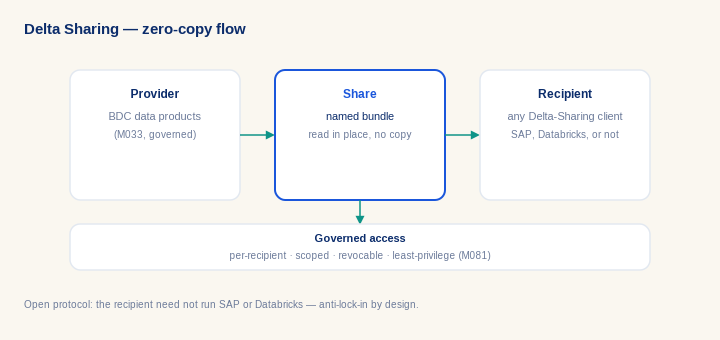
Delta Sharing is the open protocol that makes zero-copy real in SAP Business Data Cloud (BDC). It is an open-source standard that originated at Databricks, not a proprietary SAP API, and it gives recipients live read access without copying or moving data. It has three roles: provider, share and recipient. In BDC it exposes governed SAP data products to SAP Databricks, external Databricks, other clouds and partners, each reading in place. The open protocol is the anti-lock-in property, because recipients need not run SAP or even Databricks. Zero-copy does not mean uncontrolled: shares are governed, scoped per recipient, revocable, least-privilege, classified in the catalog and bound by GDPR. Share when a consumer needs live, governed access without a copy, and do not reflexively extract, because extracts duplicate data, drift and lose semantics. The protocol solves movement; the consultant still designs the flow, including latency, capacity and governance. The 2026 changes to design for: Databricks now titles its platform OpenSharing, the protocol defines two access modes (url and dir), recipients outside Databricks authenticate with a bearer token or OIDC federation, history sharing is opt-in, and SAP Databricks views can come back as custom data products, so a share can run in both directions. Retiring ETL for governed shares is the cross-stack architect skill.
What you will learn
- Explain the provider/share/recipient model and why it replaces extraction pipelines
- Design a governed share (per-recipient, scoped, revocable) using catalog classification and least-privilege roles
- Recognize the anti-patterns that turn a zero-copy win into a governance or capacity failure
- Position Delta Sharing expertise as cross-stack-architect competency in a day-rate conversation
Module overview
Delta Sharing is the open protocol behind the zero-copy promise of SAP Business Data Cloud (BDC). It was originated by Databricks and is published as open source in the delta-io/delta-sharing repository; it is not a proprietary SAP API. A provider grants a recipient read access to tables without copying them into the recipient's platform. For a consultant trained on classical SAP integration, the first question changes from "which pipeline moves this data?" to "who needs to read it, and can they read it in place?"
Prerequisites
- Intermediate hands-on experience on SAP analytics projects
- Review core concepts first: “Delta Sharing Protocol”, “BDC Connect”, “BDC Capacity Units”
Outcomes
- Explain the provider/share/recipient model and why it replaces extraction pipelines.
- Design a governed, per-recipient share with catalog classification and revocable grants.
- Apply the module's core decision: Share vs extract — choose: Delta Sharing for live governed access; avoid: Reflex physical extraction (duplicates, drifts, loses semantics).
- Track mastery with the KPI: Extraction retired (target: Live shares replace nightly extracts; red flag: New extract pipelines still being built).
Full module with the Consultant plan — €19.90/month. The full module adds: the decision framework · the end-to-end scenario walkthrough · the KPI scorecard · the anti-patterns · the code blocks · the knowledge check · the diagrams.
Open missions
32 live roles and contracts in SAP Business Data Cloud right now — see the SAP Business Data Cloud missions · freelance SAP contracts.