BDC Governance Model
As of 2026-10-10
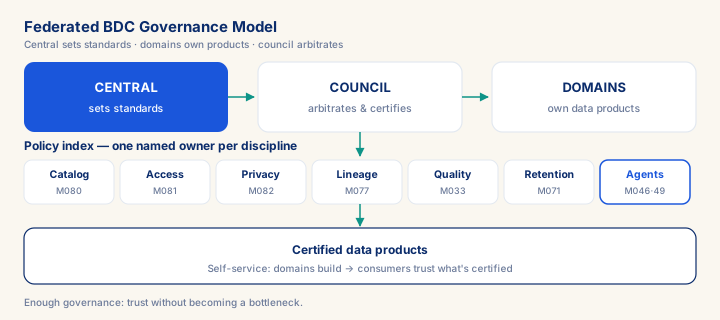
A BDC governance model is the operating system for every other discipline — roles, policies, decision rights that make BDC trustworthy at scale vs a sprawl of ungoverned products. Design it early; retrofitting onto a sprawl is far harder. Federated (data-mesh) is the model that scales: central sets STANDARDS (what "certified" means, classification taxonomy, access principles), domain teams OWN/steward their products within them (M033/M080) — neither centralised bottleneck nor decentralised chaos. Roles: platform owner, data-product owners/stewards (M080), space/access admins (M081), governance council. Ambiguous ownership → orphan products + finger-pointing. Policies span every discipline as enforceable rule: catalog/classification (M080), access (M081), privacy (M082), lineage (M077), quality contracts (M033), retention (M071), AI/agent governance (M046/M049) — the model is the index assigning each an owner. Standards make self-service safe (trust products you didn't build). Honest (/): only real if enforced + lived; heavy bureaucratic governance that drives workarounds is also failure — aim for ENOUGH governance.
What you will learn
- Design a federated governance model: central standards, domain-owned data products, and named roles (owner, steward, access admin, council)
- Apply graduated authority by risk classification — council sign-off for regulated domains, advisory review elsewhere
- Recognize the anti-patterns that break governance models — ambiguous ownership, bureaucratic overreach, ungoverned agents — and how to avoid them
- Position this skill in your personal brand and rate conversation
Module overview
A BDC governance model is the operating system for everything else this Academy teaches — the roles, policies, and decision rights that make a Business Data Cloud platform trustworthy at scale rather than a sprawl of ungoverned data products. Without it, the individual disciplines — catalog, lineage, access, privacy, quality — exist as isolated good intentions, each team doing its own version of the right thing until the versions disagree. With it, they compose into a coherent, accountable platform where a number means the same thing wherever it appears. The senior consultant designs this model early, because retrofitting governance onto a sprawling estate of self-service data products is far harder, and far more political, than designing it in from the first data product.
Prerequisites
- Intermediate hands-on experience on SAP analytics projects
- Review core concepts first: C012, C015, C010
Outcomes
- Work through a realistic scenario: Enterprise rolling out BDC across finance, supply-chain, and HR domains; early data products already sprawling with unclear ownership and inconsistent classification.
- Recognize and avoid the anti-pattern: Fully centralised governance — One team becomes the bottleneck; delivery stalls.
- Apply the module's core decision: Governance shape — choose Federated: central standards + domain ownership (data-mesh), not Fully centralised (bottleneck) or decentralised (chaos).
- Track mastery with the KPI: Federated balance (target: Central standards + domain ownership; red flag: Central bottleneck OR decentralised chaos).
Full module available to members. The full module adds: the decision framework · the end-to-end scenario walkthrough · the KPI scorecard · the anti-patterns · the code blocks · the knowledge check · the diagrams.