BDC Cost Optimization
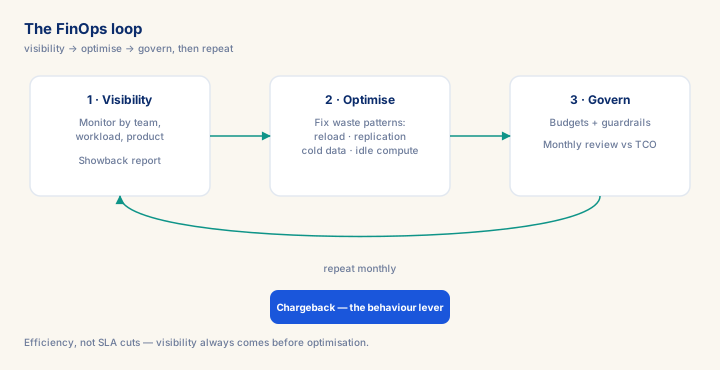
As of 2026-10-04
Cost optimisation is the continuous FinOps loop (monitor → find waste → fix → repeat) that keeps a consumption-priced BDC (M032) from bleeding money — distinct from sizing (M040, a provisioning decision). Loop: visibility (consumption monitoring M045 by workload/team/product + chargeback) → optimisation → governance (budgets/policies). Skipping to "optimise" without visibility is guessing. Recurring waste patterns + fixes (each an Academy discipline through a cost lens): full-reload→incremental (M042); over-replication→federate (M041/M048); hot cold-data→tier/archive (M071); idle compute→auto-scale/terminate; runaway ad-hoc→query budgets. Chargeback/showback changes behaviour — a team that sees its bill optimises itself (often the biggest lever). Continuous, not one-off — a monthly cost-review cadence tracking actual-vs-TCO. Honest: goal is efficiency (same outcomes, less consumption), NOT cutting capability/SLAs to hit a number. Compounding savings = the durable rate justification.
What you will learn
- Run the FinOps loop — visibility, optimisation, governance — on a live BDC/Datasphere platform
- Diagnose the five recurring waste patterns (full-reload, over-replication, cold-hot data, idle compute, runaway ad-hoc) and match each to its fix
- Design a chargeback/showback model that changes team behaviour, not just a report
- Defend a cost-optimisation plan to a sponsor without breaking SLAs — and price the recurring engagement
Module overview
Cost optimisation is the ongoing FinOps discipline that keeps a consumption-priced BDC platform (companion module M032) from quietly bleeding money — and unlike sizing (companion module M040), which is a provisioning decision, optimisation is a continuous practice: monitor, find waste, fix, repeat. In a platform where architecture equals cost, the consultant who institutionalises this loop delivers savings that compound month after month.
The FinOps loop: visibility → optimisation → governance. (1) Visibility — you cannot optimise what you cannot see, so consumption monitoring (companion module M045) by workload, team, and data product comes first; chargeback/showback makes each consumer aware of what they spend. (2) Optimisation — act on the visibility to remove waste. (3) Governance — set policies and budgets so waste doesn't creep back. Skipping straight to "optimise" without visibility is guessing.
Prerequisites
- Intermediate hands-on experience on SAP analytics projects
- Review core concepts first: C012, C015, C010
Outcomes
- Run the FinOps loop — visibility, optimisation, governance — end to end on a live BDC/Datasphere platform.
- Diagnose the five recurring waste patterns and fix each without breaking SLAs.
- Apply the module's core decision: Where to start — choose Visibility first (consumption monitoring M045 + showback), not Jumping to 'optimise' with no consumption data (guessing).
- Track mastery with the KPI: Consumption visibility (target: By workload/team/product + showback; red flag: Optimising without consumption data).
Full module available to members. The full module adds: the decision framework · the end-to-end scenario walkthrough · the KPI scorecard · the anti-patterns · the code blocks · the knowledge check · the diagrams.