
BDC Licensing, Capacity and Cost — Capacity Units, Sizing and TCO
As of 2026-11-08
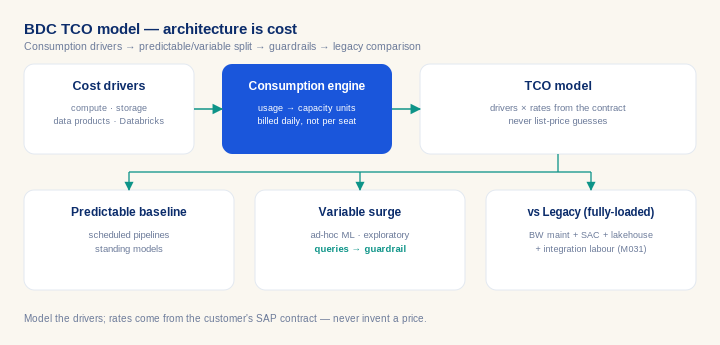
BDC is bought as a monthly pool of Capacity Units (blocks of 1 CU per month, 3 to 36 months). SAP publishes the CU value of every capacity service (SDG v2-2026, Attachment A); only the price per CU and the Intelligent Package prices are on request. This course computes a month of CU for Datasphere, SAC, SAP Databricks, premium outbound and BDC Connect from those published values, sizes a first landscape as a low/high range checked in SAP's two estimators, reads consumption in Capacities Monitoring and SAP for Me, and builds a TCO in five labelled blocks with a break-even price per CU instead of an invented one.
What you will learn
- Classify every number of a BDC quote as published (SDG Attachment A, SAP pricing page), computed or on request, and reject claims that contradict the SDG such as carried-over CUs
- Compute monthly CU for a Datasphere configuration, SAC user tiers per tenant, SAP Databricks DBU and DSU, premium outbound blocks and BDC Connect transfer from the SDG values
- Size a first BDC landscape as a low/high CU range per line, valid in Tenant Configuration and checked in the SAP Datasphere and BDC estimators, and choose an elastic compute node over base growth for read peaks
- Read consumption in Capacities Monitoring, SAC System Overview and SAP for Me → Consumption, reconcile it with metric CY475 and pick the lever that moves the right meter
- Build a BDC TCO from five labelled blocks and compute the break-even price per CU instead of assuming one
Course overview
This course teaches how SAP Business Data Cloud (BDC) is bought, what consumes capacity, how to size a first landscape, how to read consumption and how to build an auditable TCO case. Every rate below is sourced to an SAP or Databricks document with its date, computed from one with the formula shown, labelled "estimate" with a low/high range, or marked "not published" (SAP — BDC pricing).
Prerequisites
- Review core concepts first: “BDC Capacity Units”, “BDC Connect”, “Data Access Controls (DAC)”
Outcomes
- Work through a realistic scenario: CFO + procurement evaluating a BDC programme, anxious about moving from fixed SAC/BW licences to consumption billing, demanding a defensible TCO before sign-off.
- Recognize and avoid the anti-pattern: Treating TCO as a one-time procurement line — Consumption surprises mid-programme; sponsor trust collapses.
- Apply the module's core decision: TCO timing — choose: Model TCO as a design input from day one; avoid: Treating TCO as a one-time procurement line.
- Track mastery with the KPI: Pricing honesty (target: Drivers modelled; CU values from the SDG; CU price from the customer's quote; red flag: Invented list prices / CU prices).
Full module with the Consultant plan — €19.90/month. The full module adds: the decision framework · the end-to-end scenario walkthrough · the KPI scorecard · the anti-patterns · the code blocks · the knowledge check · the diagrams.
Related guides
These guides cite this page as a source.
Open missions
32 live roles and contracts in SAP Business Data Cloud right now — see the SAP Business Data Cloud missions · freelance SAP contracts.