BDC Introduction & Architecture
As of 2026-10-10
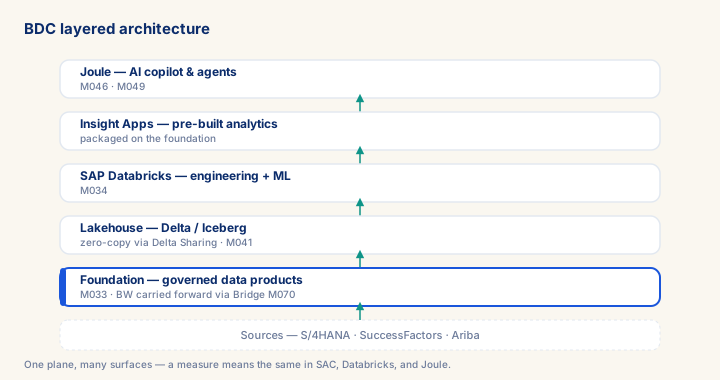
BDC (announced Feb 2025) is SAP's bid to be the AI data control plane — it unifies three formerly-separate products (Datasphere, SAC, BW) plus an OEM'd Databricks engine into one managed SaaS plane. Layered architecture: governed SAP-managed data products (M033) → open lakehouse (Delta/Iceberg) → SAP Databricks engine (M034) → Insight Apps → Joule AI/agent layer (M046/M049). The point is "one plane" — SAP data arrives with business context preserved, so a measure means the same in SAC, Databricks, or Joule. Not a BW lift-and-shift, not SAC renamed, not a generic lakehouse — the value is the governed semantic foundation. <2,000 BDC architects worldwide vs 10,000+ needed by 2028 → steepest day-rate premium in the market.
What you will learn
- Work through a realistic scenario: Enterprise on S/4HANA + legacy BW + a separate Databricks lakehouse, evaluating BDC, unsure if it's 'just BW again'.
- Recognize and avoid the anti-pattern: Pitching BDC as a BW upgrade or 'SAC renamed' — Undersells the platform; client mis-scopes the opportunity.
- Apply the module's core decision: Frame BDC as… — choose The unified governed semantic data plane, not 'Another data warehouse' / 'SAC renamed'.
- Track mastery with the KPI: Value framing (target: Stakeholders see BDC as the unified plane; red flag: BDC understood as 'BW v2' / 'SAC renamed').
Module overview
SAP Business Data Cloud (BDC), announced February 2025, is SAP's bid to be the AI data control plane for the enterprise (the platform charter; Forrester framing). For a consultant, the architectural shift is the headline: BDC unifies what used to be three separately-sold products — SAP Datasphere, SAP Analytics Cloud, and SAP BW — and an OEM'd Databricks engine into one managed SaaS data plane. Understanding that consolidation is the difference between selling "another data warehouse" and selling the platform SAP is betting the company on.
The layered architecture. From the bottom: (1) a foundation of governed, SAP-managed data products — business-ready, semantically-rich data packages sourced from S/4HANA, SuccessFactors, Ariba and more (companion module M033); (2) an open lakehouse storage layer (Delta/Iceberg) with zero-copy sharing; (3) the Databricks engine OEM'd as "SAP Databricks" for data engineering and ML directly on SAP data (companion module M034); (4) Insight Apps — pre-built analytical applications on the foundation; and (5) Joule as the AI/agent layer across the top (companion modules M046, M049). SAC and Datasphere modelling live within this plane rather than as bolt-on products.
Prerequisites
- Review core concepts first: C015, C012, C008
Outcomes
- Work through a realistic scenario: Enterprise on S/4HANA + legacy BW + a separate Databricks lakehouse, evaluating BDC, unsure if it's 'just BW again'.
- Recognize and avoid the anti-pattern: Pitching BDC as a BW upgrade or 'SAC renamed' — Undersells the platform; client mis-scopes the opportunity.
- Apply the module's core decision: Frame BDC as… — choose The unified governed semantic data plane, not 'Another data warehouse' / 'SAC renamed'.
- Track mastery with the KPI: Value framing (target: Stakeholders see BDC as the unified plane; red flag: BDC understood as 'BW v2' / 'SAC renamed').
Guides that answer with this page
These guides cite this page as one of the sources their answer rests on.