Transport & Lifecycle Management
As of 2026-10-10
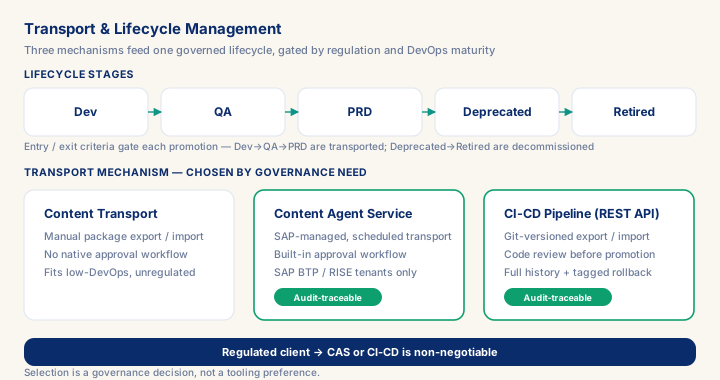
Transport readiness is a go-live gate, not a post-go-live activity. A Datasphere deployment with no defined transport path forces manual Production changes within weeks. This module equips the consultant to design the transport and lifecycle architecture before the first object is built: selecting the right mechanism (Content Transport / CAS / CI-CD), defining lifecycle governance, establishing version control, and preparing a rollback procedure. Regulated-industry clients (pharma, banking) require the audit-traceable CAS or CI-CD path. The transport architecture decision shapes the operational model for the next five years.
What you will learn
- Select the correct Datasphere transport mechanism (Content Transport, Content Agent Service, or CI-CD pipeline) for a given engagement context — documenting the selection rationale against governance, audit, and operational criteria
- Design an object lifecycle governance model — defining lifecycle stages, entry/exit criteria, and the approval workflow for each promotion step from Development to Production
- Diagnose and remediate the four transport failure modes (undefined transport path, missing dependency packaging, no approval workflow, no rollback path) — producing a transport readiness checklist for go-live
- Configure a CI-CD transport pipeline for Datasphere: export content packages via Content Agent REST API, commit to a version-controlled repository, and deploy to target tenant with documented rollback procedure
Transport and lifecycle management is the discipline that separates a Datasphere deployment that can be maintained reliably over time from one that becomes an unmaintainable patchwork of manual changes. Every senior SAP analytics consultant must understand the transport mechanisms for both the on-premise (CTS+) and cloud (Transport app and Cloud Transport Management / CI-CD pipeline via the Datasphere CLI) dimensions of the landscape — because the answer to "how do we move this from dev to prod?" determines whether the client can operate independently after go-live.
The Datasphere transport model
SAP Datasphere uses a content-level transport mechanism distinct from the ABAP Transport Management System used for S/4HANA. Datasphere objects — spaces, analytic models, flows, views, and their supporting connections — travel through one of three mechanisms, and understanding how each actually works underneath the button you click is what separates a consultant who can troubleshoot a failed transport from one who can only follow a runbook.
Prerequisites
- Intermediate hands-on experience on SAP analytics projects
- Review core concepts first: C039, C038, C041
Outcomes
- Select and justify the correct Datasphere transport mechanism for a regulated-industry client engagement.
- Design a complete object lifecycle governance model with stage-gate entry/exit criteria.
- Diagnose transport failures from symptom descriptions and produce a transport readiness checklist.
- Configure a CI-CD pipeline for Datasphere content using the Content Agent REST API and a version-controlled repository.
Full module available to members. The full module adds: the decision framework · the end-to-end scenario walkthrough · the KPI scorecard · the anti-patterns · the code blocks · the knowledge check · the diagrams.