Data Privacy & Compliance
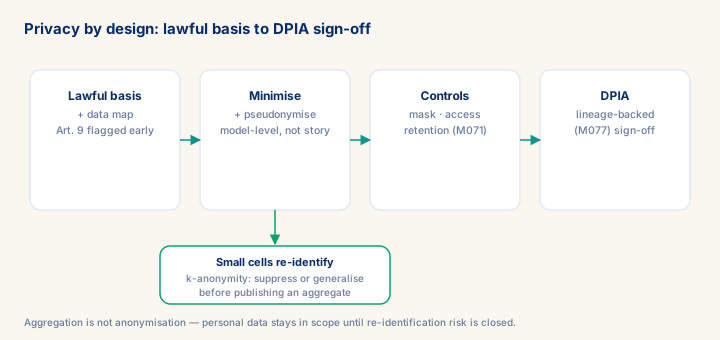
As of 2026-10-10
Privacy is a design input, not a finishing step — in EMEA that means GDPR. The principles shape modelling: lawful basis (analytics on personal data is processing), purpose limitation, data minimisation, storage limitation (tension with statutory retention, M071), right to erasure. Pseudonymisation keeps data personal; true anonymisation is hard because aggregates can re-identify (small cells = personal data dressed as statistics) — apply k-anonymity thinking. Article 9 special-category data (health/biometrics) raises the bar — flag it early (pharma M100, HR). Enforce privacy by design through the stack: catalog classification (M080) + access controls (M081) + masking + retention (M071) + lineage for the DPIA (M077). Data residency drives landscape design. The EU AI Act era rewards privacy-competent designers.
What you will learn
- Work through a realistic scenario: Insurer building customer + health-related analytics on Datasphere/SAC, EU data residency, GDPR + Article 9 special-category data, DPO requiring a DPIA.
- Recognize and avoid the anti-pattern: Privacy as end-of-build masking — Fragile or unlawful design; DPIA undefendable.
- Apply the module's core decision: When to consider privacy — choose Design-time input shaping the model, not Bolt-on masking at the end.
- Track mastery with the KPI: Lawful basis coverage (target: Documented per personal-data processing; red flag: Personal-data analytics with no lawful basis).
Data privacy is the point where analytics stops being a purely technical discipline and starts being a legal one, and in the EMEA market that is this platform's primary home, the relevant law is GDPR — the most consequential data protection regulation in the region and one whose reach extends to any organisation processing the personal data of EU residents, regardless of where that organisation itself is based. A consultant who treats privacy as a finishing step — mask a handful of columns just before go-live and consider the job done — ships analytics that is fragile at best and unlawful at worst. Privacy has to be a design input from the first modelling decision, not a compliance checklist applied after the architecture is already fixed.
The GDPR principles that actually shape analytics design
Several GDPR principles translate directly into modelling and architecture decisions, not merely into policy documents that sit in a compliance folder nobody reads during a design workshop.
Prerequisites
- Intermediate hands-on experience on SAP analytics projects
- Review core concepts first: C038, C067, C066
Outcomes
- Work through a realistic scenario: Insurer building customer + health-related analytics on Datasphere/SAC, EU data residency, GDPR + Article 9 special-category data, DPO requiring a DPIA.
- Recognize and avoid the anti-pattern: Privacy as end-of-build masking — Fragile or unlawful design; DPIA undefendable.
- Apply the module's core decision: When to consider privacy — choose Design-time input shaping the model, not Bolt-on masking at the end.
- Track mastery with the KPI: Lawful basis coverage (target: Documented per personal-data processing; red flag: Personal-data analytics with no lawful basis).
Full module available to members. The full module adds: the decision framework · the end-to-end scenario walkthrough · the KPI scorecard · the anti-patterns · the code blocks · the knowledge check · the diagrams.