
Audit & Access Logs
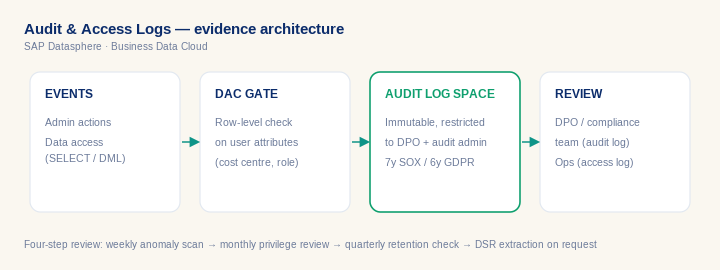
As of 2026-11-08
In a regulated Datasphere deployment the audit log is the evidence that access to personal data can be reconstructed. It supports the answer to a GDPR access request (Articles 15 and 12(3)), the data-side traceability that an AI system under the EU AI Act needs next to its own logs (Article 12), and whatever retention the client's auditors require. A consultant who designs the audit log before the first user is provisioned and hands over a working review procedure removes the most common finding in a compliance review: logging that was never switched on. This module covers the configuration, the Data Access Control audit, the regulatory mapping and the operational handover.
What you will learn
- Configure Datasphere audit logging: designate the audit log space, enable read and change policies per space, set retention per policy and verify that a test read and a test change are captured
- Audit Data Access Controls: test for bypass through a shared view and an SAP Analytics Cloud story, and list the users and service accounts that can reach rows outside a restriction
- Map audit log capabilities to GDPR access requests (Articles 15 and 12(3)) and EU AI Act record-keeping (Article 12), with the right article for each obligation, in a compliance evidence register
- Define and hand over a four-step operational review procedure (weekly anomaly review, monthly privilege review, quarterly retention check, access-request extraction) that a client team runs without the consultant
Module overview
Audit and access logs are not a post-go-live governance afterthought — they are the evidence that a Datasphere or Business Data Cloud deployment complies with GDPR, SOX, and the EU AI Act's data-traceability requirements once the architecture is in place (AI Act high-risk obligations apply from 2 December 2027). A senior consultant who designs the audit log architecture before the first user is provisioned is protecting the client from regulatory exposure. A consultant who leaves audit configuration for the operations team to sort out after go-live is leaving the client exposed to fines, audit findings, and reputational risk. The gap between those two postures is almost never technical difficulty — it is whether anyone put audit logging on the blueprint before the build started. In practice the evidence in SAP Datasphere lives in three places: space-level audit logs read through the DPP_AUDIT_LOG view, the Security > Activities log, and the data access controls on the views themselves; this module configures, tests and reviews all three.
Prerequisites
- Intermediate hands-on experience on SAP analytics projects
- Review core concepts first: C038, C041, C040
Outcomes
- Configure audit logging with retention justified per data category and confirm that read and change events are captured.
- Audit a Data Access Control and show whether row-level restriction holds through a shared view and a story.
- Map the audit log to GDPR Articles 15 and 12(3) and to EU AI Act Article 12 without mixing up articles.
- Hand over a four-step review procedure that a client team can run on its own.
Full module with the Consultant plan — €19.90/month. The full module adds: the decision framework · the end-to-end scenario walkthrough · the KPI scorecard · the anti-patterns · the code blocks · the knowledge check · the diagrams.