Change Management in SAP
As of 2026-10-10
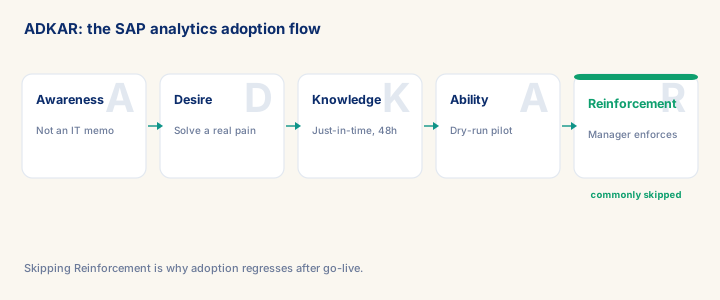
Analytics rollouts fail in adoption, not in technology — the platform is correct and the user population still runs Excel. This module applies the ADKAR framework (Awareness, Desire, Knowledge, Ability, Reinforcement) specifically to SAP analytics programmes, maps stakeholder resistance patterns (data-quality sceptic, process resistor, political resistor, technical barrier) to targeted interventions, and defines the adoption metrics — active user rate, self-service rate, legacy-system usage, data quality incident rate — that make change management measurable rather than anecdotal. The learner leaves with a resistance-pattern playbook, a stakeholder influence map, and a 90-day adoption KPI scorecard.
What you will learn
- Diagnose why SAP analytics adoption stalls even when the platform is technically correct.
- Apply the ADKAR framework to sequence awareness, desire, training, and reinforcement across a rollout.
- Map stakeholder resistance patterns — data-quality sceptic, process resistor, political resistor, technical barrier — to the intervention each one needs.
- Define and defend the adoption KPIs (active user rate, self-service rate, legacy-system usage) that prove change management is working.
Change Management in SAP Analytics: Making the Technology Adoption Actually Happen
Every failed SAP analytics implementation that was technically sound is a change management failure. The platform is live, the models are correct, the data is fresh — and six months later, 80% of the user population is still running reports from Excel. This is not a hypothetical scenario; it is the most common failure mode in enterprise analytics deployments. Understanding why this happens and how to prevent it is as important as any technical skill in the senior SAP analytics consultant's toolkit.
Why Analytics Rollouts Fail Differently from Other SAP Programmes
SAP ERP implementations fail in change management for well-documented reasons: process disruption, mandatory adoption (the old system goes away), and clear job-function impacts. Analytics implementations fail differently, and the difference makes them harder to manage.
Prerequisites
- Review core concepts first: C038, C041, C040
Outcomes
- Work through a realistic scenario: A European retail group is rolling out SAC-based sales and margin reporting to 40 country controllers who currently close the numbers in Excel every Monday morning.
- Recognize and avoid the anti-pattern: Training everyone before anyone wants the platform — Mandatory sessions run before Desire is established produce grudging compliance, not adoption.
- Apply the module's core decision: Which change framework to run — choose ADKAR for analytics rollouts — granular enough to diagnose exactly where an individual is stuck.
- Track mastery with the KPI: Active user rate (target: >= 70% of licensed users active weekly by 90 days post go-live; red flag: Below 40% at 60 days).
Full module available to members. The full module adds: the decision framework · the end-to-end scenario walkthrough · the KPI scorecard · the anti-patterns · the knowledge check · the diagrams.