
Cost Allocation & Showback
As of 2026-11-08
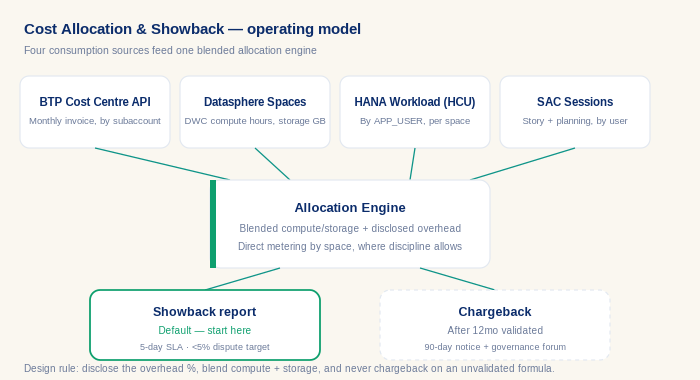
Cost Allocation & Showback is the difference between a platform team that gets funded and one that gets audited. When SAP Datasphere, BTP, and HANA Cloud consumption is centrally funded, business units treat it as free until Finance challenges the bill. This module builds the discipline to answer that challenge first: choose showback over chargeback until the allocation formula is validated (typically 12 months), blend compute and storage — a 60/40 split is a common defensible starting point — rather than pricing on one dimension, and disclose the platform overhead (often 15–25% as a planning assumption, derived from the invoice) instead of burying it. Consultants who can hand a CFO a defensible allocation model, not a spreadsheet of guesses, are the ones trusted to scale the platform budget.
What you will learn
- Work through a realistic scenario: A European logistics group runs SAP Datasphere, BTP, and HANA Cloud as a centrally funded platform. After 18 months of unchecked growth, the CFO's office has asked for a defensible cost model before approving next year's budget.
- Recognise and avoid the anti-pattern: Metering by proxy (headcount, active-user count) when direct metering is available — A small but analytically intensive team is undercharged and a large but light-touch one is overcharged; the formula fails its first serious audit.
- Apply the module's core decision: Showback or chargeback first — choose: Start with showback and hold it for 12+ months while the formula is challenged and corrected; move to chargeback only once disputes are rare and the formula survives an audit; avoid: Jumping straight to chargeback — a formula error then surfaces as a financial restatement instead of a fixable complaint.
- Track mastery with the KPI: Showback report timeliness (target: Delivered within 5 business days of month-end; red flag: Consistently over 10 business days — the platform team is chasing data, not governing cost).
Cost Allocation & Showback for SAP Analytics Platforms
Why cost visibility matters before it becomes a political crisis. When an analytics platform — SAP Datasphere, BTP, HANA Cloud, SAC — is funded centrally, every business unit perceives it as free. Consumption grows unchecked, finance eventually challenges the total bill, and the IT or data organisation scrambles to retroactively justify spend. Cost allocation and showback exist to prevent that scramble by making the relationship between platform consumption and business value legible before the invoice arrives.
Showback vs Chargeback: Choosing the Right Model
Showback means producing a detailed report of what each business unit consumed and what it cost, without moving any money. The bill stays in IT's budget; the report goes to the business. Chargeback means actually transferring the cost — debiting a business unit's budget and crediting the central platform budget, requiring approval from finance controllers, cost-centre owners, and often legal review of the internal pricing model. Showback in one formula: BU share = BU consumption ÷ total consumption × platform cost.
Prerequisites
- Intermediate hands-on experience on SAP analytics projects
- Review core concepts first: C038, C041, C040
Outcomes
- Work through a realistic scenario: A European logistics group runs SAP Datasphere, BTP, and HANA Cloud as a centrally funded platform. After 18 months of unchecked growth, the CFO's office has asked for a defensible cost model before approving next year's budget.
- Recognise and avoid the anti-pattern: Metering by proxy (headcount, active-user count) when direct metering is available — A small but analytically intensive team is undercharged and a large but light-touch one is overcharged; the formula fails its first serious audit.
- Apply the module's core decision: Showback or chargeback first — choose: Start with showback and hold it for 12+ months while the formula is challenged and corrected; move to chargeback only once disputes are rare and the formula survives an audit; avoid: Jumping straight to chargeback — a formula error then surfaces as a financial restatement instead of a fixable complaint.
- Track mastery with the KPI: Showback report timeliness (target: Delivered within 5 business days of month-end; red flag: Consistently over 10 business days — the platform team is chasing data, not governing cost).
Full module with the Consultant plan — €19.90/month. The full module adds: the decision framework · the end-to-end scenario walkthrough · the KPI scorecard · the anti-patterns · the code blocks · the knowledge check · the diagrams.