Lineage & Impact Analysis
As of 2026-10-06
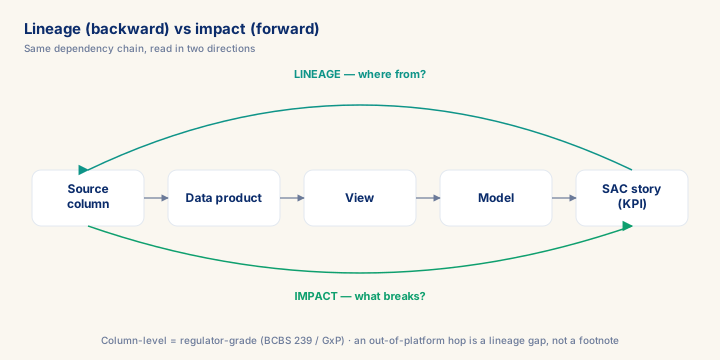
Lineage answers "where did this number come from?" (backward); impact analysis answers "what breaks if I change this?" (forward). SAP Datasphere's Impact and Lineage Analysis renders both as dependency graphs. Object-level is baseline; column-level is the standard regulators (BCBS 239) and GxP pharma need — pick granularity by compliance demand. Impact analysis is the change-safety primitive feeding change management (M084) and cutover (M075). Active metadata (derived live from model definitions) beats a stale spreadsheet diagram and is the foundation a catalog (M080) builds on. Honest limit: logic outside the platform is a lineage gap — surface it. Credibly promising "every number traces" is the senior-rate differentiator.
What you will learn
- Distinguish lineage (backward provenance) from impact analysis (forward blast-radius) and use SAP Datasphere's Impact and Lineage Analysis tool to trace a KPI back to source and a source column forward to every downstream consumer
- Decide lineage granularity (object-level vs column-level) against the compliance demand of the engagement — applying column-level lineage for BCBS 239 risk reporting or GxP-validated pharma analytics, and object-level elsewhere
- Run impact analysis before any source, transformation, or model change to enumerate every downstream consumer — converting a change into a pre-change checklist instead of a month-end surprise
- Design an active-metadata lineage capture approach (derived automatically from live model definitions) and explicitly register out-of-platform lineage gaps (spreadsheet hops, undocumented ABAP, manual uploads) rather than letting the diagram imply false completeness
Module overview
Lineage and impact analysis answer the two questions every governed analytics estate must answer on demand: "where did this number come from?" (lineage, backward) and "what breaks if I change this?" (impact, forward). In a regulated estate these are not nice-to-haves — they are the difference between a clean audit and a finding (companion module M097 Banking BCBS 239; companion module M100 Pharma ALCOA+). In any estate, they are the difference between a confident change and a Friday-night incident.
Lineage is backward traversal; impact is forward. Start from a KPI on a SAC story and walk back through the analytic model, the views, the data products, the source tables — that is lineage (provenance). Start from a source column and walk forward to every model, story, and report that consumes it — that is impact analysis. SAP Datasphere ships an Impact and Lineage Analysis tool that renders both as dependency graphs; the senior skill is reading them to make safe change decisions, not just admiring the diagram.
Prerequisites
- Intermediate hands-on experience on SAP analytics projects
- Review core concepts first: C037, C040, C038
Outcomes
- Explain the difference between lineage and impact analysis and demonstrate both using SAP Datasphere's Impact and Lineage Analysis tool.
- Select the correct lineage granularity (object vs column-level) for a given compliance context and justify the choice.
- Run a pre-change impact analysis and produce a downstream-consumer checklist before a source or model change.
- Identify and register lineage gaps introduced by out-of-platform logic, and explain why active metadata is required to keep lineage evidence trustworthy.
Full module available to members. The full module adds: the decision framework · the end-to-end scenario walkthrough · the KPI scorecard · the anti-patterns · the code blocks · the knowledge check · the diagrams.