
Data Quality Fundamentals
As of 2026-11-08
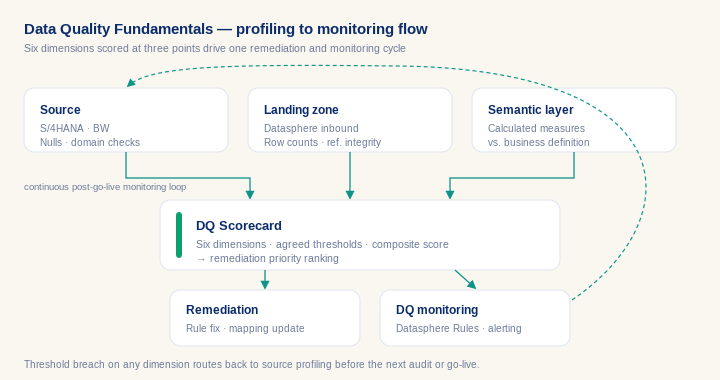
Data quality issues are a frequent cause of business distrust in analytics systems. The consultant who quantifies DQ — with dimension-level scores, profiling evidence, and business-agreed thresholds — converts a vague complaint into a governance artefact and an advisory engagement. The DQ scorecard is the anchor. The six dimensions (completeness, accuracy, consistency, timeliness, uniqueness, validity) each require a different measurement technique; conflating them leads to remediation that never finishes. Post-go-live, documented Datasphere features keep DQ from regressing after migration: validation rules on views (data validation) and checks inside task chains with failure notifications.
What you will learn
- Profile a data extraction scope across the six DQ dimensions (completeness, accuracy, consistency, timeliness, uniqueness, validity) — producing dimension-level scores for each object using SAP Datasphere profiling tools
- Build a DQ scorecard for an analytics migration or go-live scope — with measured dimension scores, business-agreed thresholds, composite scores, and a remediation priority ranking
- Diagnose the five DQ failure modes on SAP analytics engagements (no pre-modelling profiling, undefined thresholds, accuracy/completeness confusion, deferred deduplication, no post-go-live monitoring) and prescribe the correct remediation for each
- Design a post-go-live DQ monitoring configuration in Datasphere — specifying view validation rules, task chain checks with notifications, threshold values and remediation workflow for a production analytics estate
Module overview
Data quality is a credibility-critical skill on any analytics engagement, precisely because it is invisible until it fails in public. A consultant who cannot quantify a data quality issue — measure it against a defined dimension, express it as a number a business stakeholder can act on, and propose a remediation path with a cost and a priority — is the consultant who loses the room the first time a dashboard number looks wrong in front of an executive. This module builds the practitioner's data quality toolkit from first principles: the dimensions that make quality measurable, the scorecard that turns measurement into a governance decision, the profiling techniques that produce the measurements in the first place, the failure modes that recur across engagements, and the monitoring configuration that keeps quality from silently decaying after go-live. In practice the toolkit rests on three things you can open in SAP Datasphere: the Data Validation panel of a view (rules such as Unique Key Values and Referential Integrity), SQL views that you write to measure the dimensions no rule covers, and Task Chains that run those checks on a schedule.
Source: SAP Datasphere documentation — Validating View Data
Prerequisites
- Review core concepts first: C041, C038, C037
Outcomes
- Profile a data scope using the six DQ dimensions and produce mechanically-derived dimension-level scores.
- Build and present a DQ scorecard with business-agreed thresholds and remediation priorities.
- Diagnose and remediate each of the five DQ failure modes on SAP analytics engagements.
- Set up post-go-live monitoring with Data Validation rules on views and SQL check views, run by a task chain with e-mail notification on failure.
Full module with the Consultant plan — €19.90/month. The full module adds: the decision framework · the end-to-end scenario walkthrough · the KPI scorecard · the anti-patterns · the code blocks · the knowledge check · the diagrams.