Zero-Trust for SAP Analytics
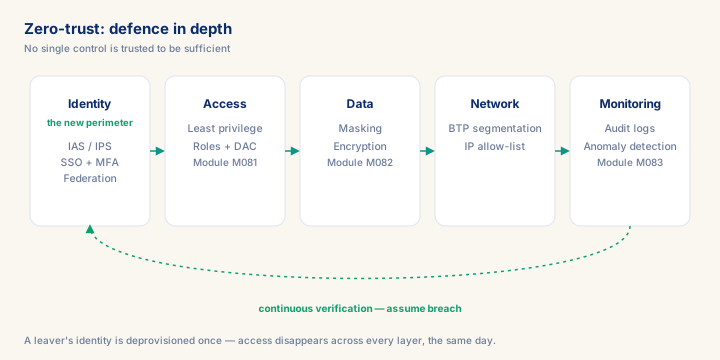
As of 2026-10-10
Zero-trust replaces perimeter trust with "never trust, always verify; assume breach; least privilege everywhere" — the only coherent security model once SAC, Datasphere and BDC dissolve the corporate network perimeter. The single highest-leverage first move is identity: central SAP Cloud Identity Services (IAS/IPS), SSO and mandatory MFA, so a leaver's access disappears everywhere the same day — the exact control an auditor tests first (a joiner-mover-leaver check, not a policy document). Everything else — least-privilege data access (M081), encryption evidenced end to end (M082), breach-detecting monitoring (M083) — is staged behind that, in priority order, never claimed all at once. Consultants who can design and stage a real zero-trust posture, rather than rebrand an SSO rollout, sit in the security-architecture tier of day-rate — the premium bracket regulated clients pay for, above generic BI delivery.
What you will learn
- Explain why zero-trust replaces perimeter security once SAC, Datasphere and BDC dissolve the corporate network boundary
- Design an identity-first rollout: SAP Cloud Identity Services (IAS/IPS), SSO, mandatory MFA, and federated deprovisioning
- Tell real zero-trust maturity apart from SSO-only security theatre — and name where a client actually sits on the curve
- Position zero-trust architecture skills in a security-tier rate conversation with a client
Module overview
Zero-trust is the security model that replaces "trust the network perimeter" with "never trust, always verify; assume breach; least privilege everywhere." For SAP analytics it reframes security from "is the user inside the corporate network?" to "is this specific identity, on this device, allowed to do this specific thing with this specific data, right now?" In a cloud-delivered estate (SAC, Datasphere, BDC on BTP) the perimeter has effectively dissolved — zero-trust is the coherent answer. (SAP BTP has since been renamed SAP Business AI Platform, announced at SAP Sapphire 2026.)
The four principles, applied to analytics. (1) Verify explicitly — authenticate and authorise every access on identity + context (device, location, risk), not on network position. (2) Least privilege — the same principle as authorization design (companion module M081), enforced everywhere, just-enough and just-in-time. (3) Assume breach — design as if an attacker is already inside: segment, encrypt, monitor, limit blast radius. (4) Continuous verification — access isn't granted once at login; it's continuously re-evaluated as context changes.
Prerequisites
- Intermediate hands-on experience on SAP analytics projects
- Review core concepts first: C038, C041, C040
Outcomes
- Explain why zero-trust replaces perimeter security in a cloud-delivered SAP analytics estate.
- Design and stage an identity-first zero-trust rollout.
- Apply the module's core decision: Trust model — choose Verify per-access on identity+context, not Trusting the corporate-network perimeter.
- Track mastery with the KPI: Identity federation (target: One governed identity; MFA enforced; red flag: Fragmented local accounts; no MFA).
Full module available to members. The full module adds: the decision framework · the end-to-end scenario walkthrough · the KPI scorecard · the anti-patterns · the code blocks · the knowledge check · the diagrams.