Chemical & Process Industries
As of 2026-10-05
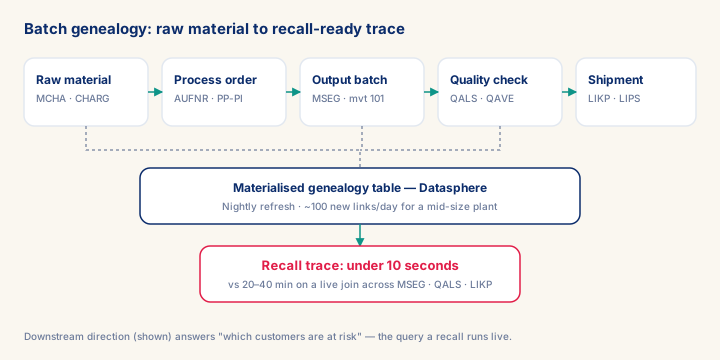
Chemical and process industry analytics on SAP turns on one decision: build a materialised batch-genealogy layer in Datasphere or BW/4HANA, because live joins across MCHA, MSEG, QALS and LIKP take 20-40 minutes -- unusable when a product-recall decision is time-critical -- while a pre-computed table answers the same trace in under 10 seconds. The consultant who can span all five source modules (PP-PI, QM, EHS, LO-BM, and the semantic layer) and ship a compliant genealogy-to-yield-to-REACH reporting chain is rare enough to set the rate ceiling in industrial analytics, because most practitioners know only one or two of the five domains. The stake for a GMP or REACH client is regulatory, not cosmetic: a batch-release report that cannot trace to a signed inspection result under 21 CFR Part 11 fails the audit, and a substance-volume report that ignores the EHS specification link gets rejected by the regulator. Leave this module with the genealogy data model, the yield decision framework, and the language to defend both in front of a quality director.
What you will learn
- Work through a realistic scenario: A specialty chemical manufacturer -- three sites, 200 finished products from 150 raw materials.
- Recognize and avoid the anti-pattern: Reporting genealogy from MSEG without checking batch classification is active — If the plant tracks only at material level, not batch level.
- Apply the module's core decision: HANA Cloud vs BW/4HANA vs Datasphere for process analytics — choose Datasphere when the requirement spans SAP plus LIMS/DCS/Databricks.
- Track mastery with the KPI: Recall trace time (downstream genealogy).
Module overview
Chemical and process industry analytics on SAP is defined by one distinctive constraint: the product is a substance, not a discrete part, and its properties — purity, yield, viscosity, batch genealogy — are the primary analytics objects. A chemical plant does not produce 10,000 widgets; it produces 10,000 tonnes of a compound where each batch has a measured quality profile that must be traceable from raw material receipt to customer shipment, for both quality-management and regulatory reasons (REACH, GMP, FDA 21 CFR Part 11 in pharmaceutical chemical manufacturing).
Prerequisites
- Intermediate hands-on experience on SAP analytics projects
- Review core concepts first: C087, C083, C046
Outcomes
- Work through a realistic scenario: A specialty chemical manufacturer -- three sites, 200 finished products from 150 raw materials.
- Recognize and avoid the anti-pattern: Reporting genealogy from MSEG without checking batch classification is active — If the plant tracks only at material level, not batch level.
- Apply the module's core decision: HANA Cloud vs BW/4HANA vs Datasphere for process analytics — choose Datasphere when the requirement spans SAP plus LIMS/DCS/Databricks.
- Track mastery with the KPI: Recall trace time (downstream genealogy).
Full module available to members. The full module adds: the decision framework · the end-to-end scenario walkthrough · the KPI scorecard · the anti-patterns · the code blocks · the knowledge check · the diagrams.