Apache Airflow Integration
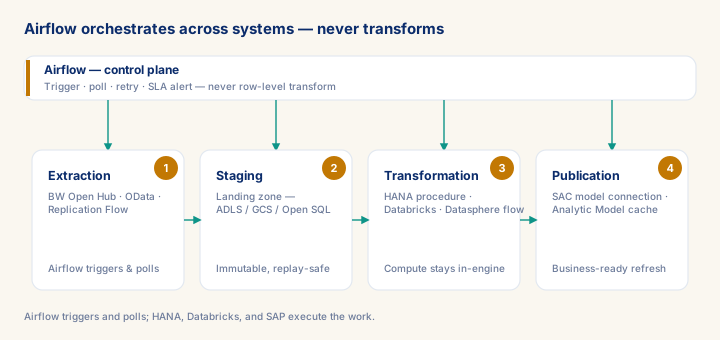
As of 2026-10-04
SAP's own schedulers — BW Process Chains, S/4HANA Job Scheduling, Datasphere Task Chains — stop working the moment a load has to cross into Databricks, an external data lake, or a custom quality check; Airflow is what closes that gap. The decision that matters on a BDC or Datasphere migration is where the DAG's boundary sits: Airflow should trigger and poll, never pull rows into its own worker to transform them, or every load above a few thousand rows becomes a bottleneck and a blind spot. Consultants who can design a retry-safe, SLA-alerted, multi-system DAG — and who know why a Datasphere OAuth token needs refreshing mid-run, not just at DAG start — command €950–1,350/day in the EMEA market, more on financial-close or S&OP work where a missed SLA has board-level visibility.
What you will learn
- Design multi-layer Airflow DAGs for SAP analytics loads — separating extraction triggering (BW Process Chain, S/4HANA OData, Datasphere Replication Flow) from staging and transformation, with atomic idempotent tasks and correct retry logic for SAP-specific failure modes
- Implement Airflow-to-HANA connectivity using the apache-airflow-providers-sap-hana package with credential store management, SSL configuration, and HANA stored procedure orchestration patterns for BW/4HANA Open Hub scenarios
- Integrate Datasphere Task Chains and Transformation Flows into Airflow DAGs via the Datasphere REST API, including OAuth2 token lifecycle management for long-running DAG executions
- Configure SLA-based alerting that routes operational signals to business stakeholders (not just engineering), and instrument task duration metrics to detect HANA performance regressions before they breach SLA windows
Why Airflow Orchestrates SAP Loads Rather Than SAP's Own Tools
SAP has its own scheduling and process orchestration tools: BW Process Chains, S/4HANA Job Scheduling via the ABAP Job Framework, Datasphere Task Chains, and the SAP Integration Suite's Integration Flows. Each of these is excellent within its own domain. The reason Airflow appears in SAP analytics landscapes is that none of them cross domain boundaries cleanly. A Datasphere Task Chain cannot wait for a Databricks notebook running in BDC to finish. An SAP Job Framework ABAP job cannot trigger a Python-based quality check in an external data lake. An Integration Flow cannot express a complex dependency graph with branching logic, failure recovery, and SLA-based alerting.
Airflow solves the inter-system dependency problem — it becomes the conductor that sequences work across SAP HANA, Datasphere, S/4HANA OData, Databricks, GCS/Azure Blob/S3, and custom Python operators, all within a single DAG where dependencies, retries, and monitoring are expressed in code.
Prerequisites
- Intermediate hands-on experience on SAP analytics projects
- Review core concepts first: C087, C083, C047
Outcomes
- Work through a realistic scenario: A European industrial manufacturer is migrating its BW/4HANA finance-close loads into Datasphere and Databricks under SAP Business Data Cloud.
- Recognize and avoid the anti-pattern: Pulling data into the Airflow worker for transformation (PythonOperator + pandas).
- Apply the module's core decision: Airflow vs. native SAP orchestration (BW Process Chains, Datasphere Task Chains) — choose Use Airflow only where dependencies cross system boundaries.
- Track mastery with the KPI: SLA-miss rate on the finance-close DAG (target: 0 misses per month on the 07:00 dashboard SLA; red flag: More than 1 miss/month with no stakeholder-visible root cause).
Full module available to members. The full module adds: the decision framework · the end-to-end scenario walkthrough · the KPI scorecard · the anti-patterns · the code blocks · the knowledge check · the diagrams.
Guides that answer with this page
These guides cite this page as one of the sources their answer rests on.