Graph Analytics & SAP HANA Graph
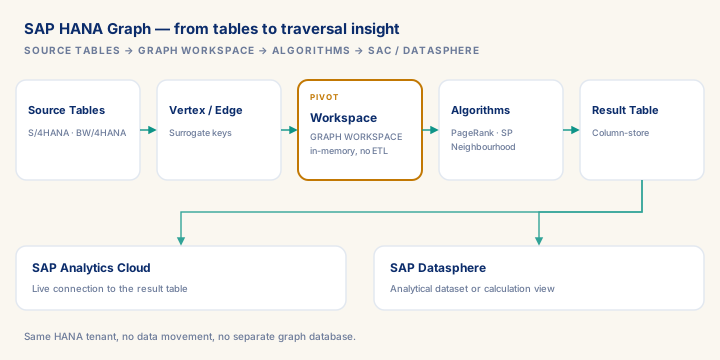
As of 2026-10-03
SAP HANA Graph turns questions relational SQL cannot answer efficiently — supplier-risk cascades, cross-sell centrality, skills-matching — into traversal queries that run in the same HANA tenant already serving BW/4HANA or Datasphere, with no separate graph database and no ETL. In production engagements this has cut an 8-hour overnight batch supplier-risk job to 4 minutes, and lifted cross-sell conversion from 11% to 38% by ranking accounts on network centrality instead of RFM segmentation. The scarce skill is not the Cypher-style MATCH syntax — it is deciding what is a vertex, what is an edge, and when a problem is genuinely graph-shaped rather than a badly written SQL join. Practitioners who can do this credibly command a 15-25% day-rate premium over general HANA modelling, with senior DACH/France rates currently at €1,100-€1,450/day.
What you will learn
- Identify when a business question requires graph traversal rather than relational aggregation and select the appropriate HANA Graph algorithm
- Design vertex and edge table schemas from SAP source data, handling composite keys, directionality, and edge volume constraints
- Implement a HANA Graph workspace, execute built-in algorithms (PageRank, shortest path, neighbourhood search), and expose results to SAC via calculation views
- Size graph workspaces for memory impact on shared HANA tenants and define incremental-refresh procedures for production stability
When Relational Falls Short
SAP HANA's relational engine excels at aggregating facts along dimensional hierarchies—sales by region, profit by cost-centre, stock movements by plant. It struggles the moment the question is about connections rather than attributes. Who influenced whom in a customer-adoption network? Which supplier sits on the critical path of a multi-tier procurement graph? Which consultants are three hops away from a given practice lead on a collaboration graph? These are graph problems, and forcing them onto relational joins produces either combinatorial explosion or query plans that time out on live HANA instances.
SAP HANA Graph is the native answer. Introduced as a core engine component in HANA 2.0 SPS 01 and progressively hardened through SPS 06, it operates on graph workspaces—vertex tables (entities) and edge tables (relationships) stored as ordinary HANA column-store tables, queried through the openCypher-compatible GRAPH SQL extension. The graph engine runs in-process with the column store, which means no data movement and no ETL to a separate graph database. That architectural choice is decisive for SAP analytics workloads: the same HANA instance that holds BW/4HANA InfoProviders or Datasphere remote tables can simultaneously serve graph traversal queries over the same physical data.
Prerequisites
- Intermediate hands-on experience on SAP analytics projects
- Review core concepts first: C028, C087, C083
Outcomes
- Work through a realistic scenario: A French aerospace tier-1 supplier running S/4HANA Sourcing and Procurement needs to know, in near real time.
- Recognize and avoid the anti-pattern: Building the workspace on unfiltered transactional history — A five-year, 200-million-row purchase-order table fails to load; always materialise a filtered.
- Apply the module's core decision: Graph traversal vs relational aggregation — choose Model it as a HANA Graph workspace once the SQL already needs five or more self-joins, a recursive CTE.
- Track mastery with the KPI: Query latency vs the relational baseline.
Full module available to members. The full module adds: the decision framework · the end-to-end scenario walkthrough · the KPI scorecard · the anti-patterns · the code blocks · the knowledge check · the diagrams.