Synthetic Data Generation
As of 2026-10-10
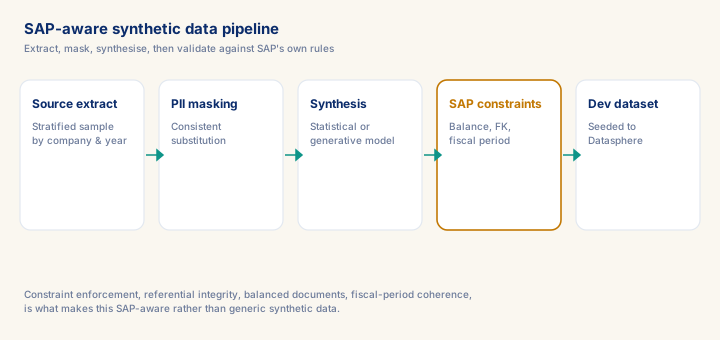
Synthetic Data Generation decides whether a SAP analytics development environment can be tested realistically without ever touching production personal data — a GDPR Article 5 and 25 requirement, not a nice-to-have. The number that matters: CTGAN and other generative models need 10,000+ training rows per entity before they generalise instead of memorising real records, so most SAP tables call for simpler statistical synthesis or rule-based generation. The day-rate stake: EMEA freelancers who can design a compliant masking-plus-synthesis pipeline for SAP data — covering referential integrity, balanced accounting documents, and fiscal-period coherence — bill €700-850/day in 2025-2026 with a clear compliance narrative to a buyer.
What you will learn
- Select and configure synthetic data generation methods appropriate to the statistical properties and relational constraints of SAP transactional and master data
- Apply GDPR-compliant data masking and synthesis techniques that preserve realistic distributions for SAP analytics development and UAT without exposing personal data
- Evaluate the honest limits of synthetic SAP data: where it enables accurate development, where distribution shift makes it misleading, and how to measure the gap
- Build a reproducible synthetic data pipeline for a SAP analytics development environment using open-source tools integrated with Datasphere or a cloud data warehouse
Why synthetic data is not optional in SAP analytics development
SAP systems contain some of the most sensitive business data an enterprise holds: payroll, customer purchasing behaviour, supplier contracts, patient records in healthcare ERP, financial positions. Development and testing on production data is both a GDPR violation (Article 5(1)(b) — purpose limitation; Article 25 — data protection by design) and a security risk. Yet development without realistic data produces analytics that fail in production: a Datasphere transformation built on a test system with 500 rows of uniform orders will miss the performance and edge-case problems that appear on 50 million rows with seasonal spikes and outlier materials.
Synthetic data bridges this gap, but only when it is generated with genuine understanding of SAP's data structures. This module treats synthetic data generation as an engineering discipline, not a privacy checkbox.
Prerequisites
- Intermediate hands-on experience on SAP analytics projects
- Review core concepts first: C087, C083, C047
Outcomes
- Work through a realistic scenario: A European industrial manufacturer migrating finance and sales data to S/4HANA and Datasphere needs a development environment where dbt models and Datasphere transformations.
- Recognize and avoid the anti-pattern: Masking numerical analytical fields instead of synthesising them.
- Apply the module's core decision: Which synthesis method for this field — choose Mask PII identifiers with consistent substitution; shuffle categorical dimensions.
- Track mastery with the KPI: PII field coverage (target: 100% of identified personal-data fields masked or removed; red flag: Any IBAN, email, name, or national-ID pattern detected in the output).
Full module available to members. The full module adds: the decision framework · the end-to-end scenario walkthrough · the KPI scorecard · the anti-patterns · the code blocks · the knowledge check · the diagrams.