Causal Inference for Business
As of 2026-10-03
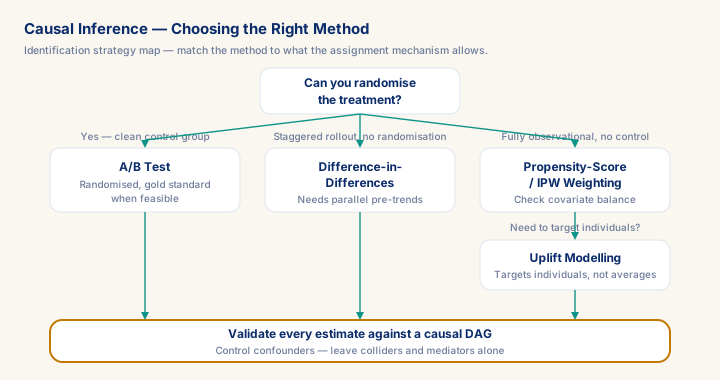
Every SAP analytics team can tell a client what happened; few can tell them what caused it — and that gap is where causal inference earns its premium. This module gives you three production-grade methods (difference-in-differences, propensity-score weighting, uplift modelling) to answer intervention questions directly on HANA, BW/4HANA, and Datasphere transactional data, without waiting six months for a clean A/B test. You leave able to build a difference-in-differences model on SD order data, defend the parallel-trends assumption to a sceptical FI controller, and target a promotion at the customers it will actually move — not just the ones who would have bought anyway. In EMEA pricing, retail, and pharma engagements, a causal evaluation component is increasingly a named line in the statement of work; consultants who can design the measurement strategy, not just run the regression, move from the delivery stream into the architecture and strategy tier of the deal.
What you will learn
- Apply difference-in-differences and propensity score methods to evaluate business interventions using SAP transactional data in HANA and BW/4HANA, correctly identifying and controlling for confounders while avoiding post-treatment bias.
- Build and validate uplift models that distinguish persuadable customers from sure-things and do-not-disturbs, using hana-ml in-database processing to produce targeted treatment recommendations for pricing and churn use cases.
- Construct and interpret directed acyclic graphs (DAGs) for multi-module SAP data joins — across FI, SD, MM, and SuccessFactors — to make confounding assumptions explicit and select the correct adjustment set before any causal analysis.
- Design measurement strategies that determine when A/B testing is operationally feasible in an SAP S/4HANA environment and when observational causal methods must substitute, communicating the trade-offs and validity conditions to business stakeholders.
Why Standard Analytics Fails to Answer Causal Questions
Most SAP analytics work is descriptive or predictive: how many units sold, which customers will churn next quarter, what revenue is projected. These are valuable questions, but they share a blind spot — they cannot answer why something happened or what would happen if we changed X. Causal inference fills that gap. For an SAP analytics consultant, mastering it means moving from producing reports that describe the past to producing analyses that guide decisions about the future with quantified confidence.
Consider a pricing team that ran a 10% discount on a product line last quarter and saw a 15% volume uplift. Did the discount cause the uplift? Possibly — but regional economic conditions improved, a competitor had stock-outs, and the campaign ran alongside an above-the-line TV spend. Standard regression on ACDOCA or DSO data will conflate all these. Causal inference methods exist precisely to disentangle these effects, and they work directly on the transactional and CRM data that lives in HANA, BW/4HANA, and Datasphere.
Prerequisites
- Intermediate hands-on experience on SAP analytics projects
- Review core concepts first: C087, C083, C047
Outcomes
- Work through a realistic scenario: A pan-European specialty pharma distributor rolled out a new rebate programme to its German wholesalers in Q1 but.
- Recognize and avoid the anti-pattern: Reading a high R² or AUC as proof of causation — A predictive pricing-elasticity model gets presented as a causal one.
- Apply the module's core decision: Which causal method fits the intervention.
- Track mastery with the KPI: Pre-trend parallelism (target: Treated and control slopes statistically indistinguishable over the 12 months before treatment).
Full module available to members. The full module adds: the decision framework · the end-to-end scenario walkthrough · the KPI scorecard · the anti-patterns · the code blocks · the knowledge check · the diagrams.