Edge Analytics & IoT
As of 2026-10-03
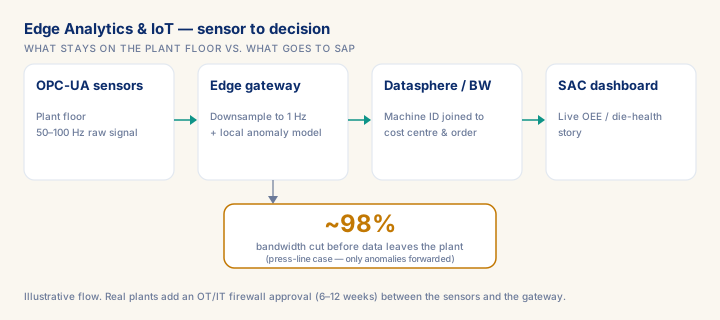
Edge Analytics & IoT is the decision that keeps a die-fault interlock reacting in under 20 milliseconds instead of waiting 80-300ms for a cloud round trip -- a distinction that decides whether a multi-million-euro press line stays running. Done right, filtering at the edge cuts WAN traffic by roughly 98% (only 0.3-2% of press strokes are anomalous) while still landing the context SAP S/4HANA needs -- cost centre, production order, material -- in Datasphere or BW/4HANA. The scarce skill is OT-layer fluency (OPC-UA, MQTT, the Purdue Model), not Datasphere itself: DACH day rates for this profile run 20-35% above standard implementation rates. The trap is treating edge as a bandwidth-cost play instead of a latency and sovereignty decision -- get the boundary wrong and either the interlock misses its window or the client's works council blocks the deployment.
What you will learn
- Design an edge-to-Datasphere IoT integration architecture for a manufacturing client, selecting the correct SAP Edge Services components and specifying the OPC-UA to MQTT to Datasphere data flow.
- Apply the streaming-vs-batch decision framework to a given industrial use case, quantifying latency, bandwidth, and sovereignty trade-offs to justify the edge compute boundary.
- Identify and mitigate the four most common edge deployment failure modes in SAP landscapes: OT/IT network separation, SAP Edge Services lifecycle management, ERP-context dependency, and false CAPEX assumptions.
- Scope and position an edge analytics engagement commercially, distinguishing it from standard Datasphere implementation and articulating the OT-layer expertise premium to a client stakeholder.
Why Edge Matters in SAP Analytics Landscapes
Edge analytics is not a new concept, but it has become operationally consequential in SAP landscapes over the last three years as manufacturing clients accelerate Industry 4.0 programmes and logistics operators deploy real-time route intelligence. The premise is deceptively simple: move computation closer to where data originates, rather than routing everything to a central cloud. The implications -- architectural, commercial, and governance-related -- are anything but simple.
Prerequisites
- Intermediate hands-on experience on SAP analytics projects
- Review core concepts first: C087, C083, C047
Outcomes
- Work through a realistic scenario: A Tier-1 automotive supplier running 200+ press lines needs real-time die-fault detection without saturating plant WAN.
- Recognize and avoid the anti-pattern: Treating edge as a cost-reduction play first — CAPEX (appliances, network hardening) and OPEX.
- Apply the module's core decision: Where to draw the edge/cloud compute boundary — choose Keep sub-second safety/quality actions (interlocks, line-stops) on the edge appliance.
- Track mastery with the KPI: WAN bandwidth reduction (target: >= 90% vs).
Full module available to members. The full module adds: the decision framework · the end-to-end scenario walkthrough · the KPI scorecard · the anti-patterns · the code blocks · the knowledge check · the diagrams.