Blockchain for Supply Chain
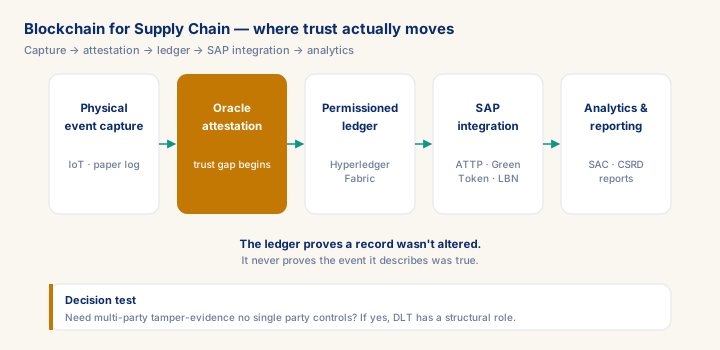
As of 2026-10-04
Blockchain for supply chain is a scoping skill, not an implementation skill, for almost every SAP analytics engagement: the real work is telling a client honestly whether their use case needs multi-party tamper-evidence that no single party controls, or whether a conventional database with role-based access solves it faster and cheaper. SAP's own portfolio backs that judgment -- the company quietly retired its blockchain-as-platform ambition after 2021 and now delivers the same transparency outcomes through non-blockchain multi-party SaaS (Logistics Business Network, Green Token). The two places DLT still earns its cost are regulator-mandated pharma serialisation (EU FMD / US DSCSA networks such as MediLedger) and 3TG conflict-minerals chain-of-custody under the CSDDD -- everywhere else, consortium legal and governance costs typically run 2-5x the technology spend. Blockchain-as-specialisation day rates have contracted sharply in EMEA since 2022; the durable, billable skill is the adjacent analytics work -- CSRD reporting on Green Token mass-balance data and ATTP serialisation dashboards in SAP Analytics Cloud.
What you will learn
- Distinguish the tamper-evidence guarantee that DLT genuinely provides from the broader trust claims in vendor marketing, and apply this distinction to evaluate whether a specific supply chain use case requires DLT or a conventional database.
- Map SAP's current product portfolio accurately -- SAP LBN, SAP Green Token, SAP ATTP, and the deprecated SAP Blockchain Application Enablement -- to the supply chain transparency and traceability problems each actually addresses.
- Diagnose the three structural failure modes of supply chain DLT projects (the oracle problem, network adoption risk, and cost-at-scale) and structure a client advisory that surfaces these risks before project commitment.
- Identify the specific points in an SAP analytics landscape where DLT-adjacent data (Green Token mass balance, ATTP serialisation events) influences a CSRD or regulatory compliance analytics deliverable.
An Honest Starting Point: What Blockchain Is and Is Not
Blockchain for supply chain is one of the most consistently over-sold technology narratives of the past decade. SAP analytics consultants who work with procurement, logistics, or manufacturing clients will encounter it -- in RFPs, in executive briefings, in sustainability reporting requirements. The professional obligation is to understand it precisely enough to evaluate it honestly, rather than repeating either the hype or the reflexive dismissal.
A blockchain (or more precisely, a distributed ledger technology, DLT) is a data structure in which records are grouped into cryptographically linked blocks, replicated across multiple independent nodes, and governed by a consensus protocol that makes retroactive modification computationally expensive or practically impossible without cooperation from a majority of the network. The word trust appears constantly in DLT marketing. What it actually delivers is tamper-evidence -- a strong guarantee that a record has not been altered after it was written, provided you trust the process by which the record was created in the first place. That last clause is the one that most supply chain DLT projects stumble on.
Prerequisites
- Review core concepts first: C087, C083, C047
Outcomes
- Work through a realistic scenario: A German automotive Tier-1 supplier under CSRD and EU Conflict Minerals disclosure pressure asks whether to join an existing DLT-based responsible-sourcing consortium.
- Recognize and avoid the anti-pattern: Recommending DLT to solve a single-company data problem.
- Apply the module's core decision: DLT vs. a conventional database — choose Recommend DLT only when multi-party trust is structurally absent -- competing suppliers.
- Track mastery with the KPI: Oracle verification coverage (target: 100% of ledger writes backed by an independent attestation).
Full module available to members. The full module adds: the decision framework · the end-to-end scenario walkthrough · the KPI scorecard · the anti-patterns · the code blocks · the knowledge check · the diagrams.