Quantum Computing Primer for SAP
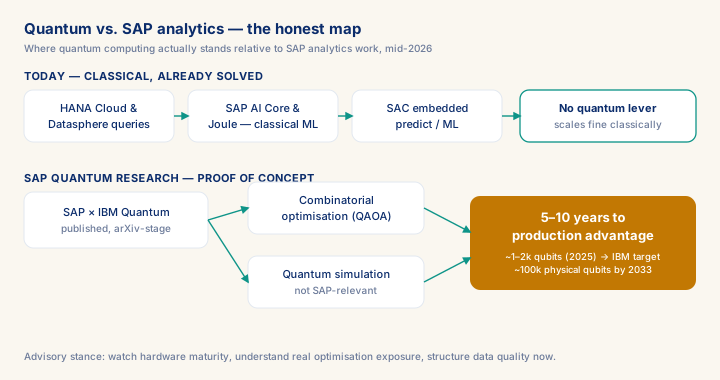
As of 2026-10-03
Quantum computing has no production use in SAP analytics today, and won't for at least five to ten years — treat it as a watch item, not a roadmap line. The one place it could eventually matter is combinatorial optimisation (production scheduling, logistics, portfolio construction), where S/4HANA and TM still rely on classical heuristics; SAP's own research with IBM Quantum is proof-of-concept, not GA. The credible advisory position is: watch hardware maturity (error-corrected logical qubits, not marketing qubit counts), understand which client processes have real optimisation exposure, and fix data quality now so a future pilot isn't sunk by incomplete master data. A senior consultant who holds this calibrated line — neither hyping quantum nor dismissing it — earns the top of the advisory rate band; one who puts "Quantum AI" on a year-3 roadmap burns client trust when it doesn't ship.
What you will learn
- Explain the principles of quantum superposition, entanglement, and quantum advantage in plain language, and accurately assess which SAP-relevant problem classes (combinatorial optimisation, simulation) have theoretical quantum relevance versus which do not
- Describe the current state of quantum hardware maturity (qubit counts, error rates, coherence times) and explain why practical quantum advantage for SAP analytics workloads is at minimum five to ten years away under current scaling trajectories
- Distinguish SAP's actual quantum research activities and partnerships from production-available product features, and present this accurately to a CTO or innovation board without overstating or dismissing
- Structure a client conversation on quantum readiness that identifies whether any of the client's business processes contain combinatorial optimisation problems that are candidates for eventual quantum advantage, and define the classical pre-requisites needed before quantum integration is feasible
What Quantum Computing Actually Is
Quantum computing is a fundamentally different model of computation, not a faster version of classical computing. Classical computers process information as bits with values of 0 or 1. A quantum computer processes information using qubits, which exploit quantum mechanical phenomena — superposition and entanglement — to represent and manipulate information in ways that have no classical analogue. A qubit in superposition is not simultaneously 0 and 1; it is in a probabilistic quantum state that collapses to a definite 0 or 1 when measured. The utility of quantum computation arises from the ability to manipulate these probabilistic amplitudes across many qubits simultaneously, allowing certain algorithms to explore a vast solution space in far fewer steps than any classical algorithm can.
The critical word is "certain." Quantum advantage — the point at which a quantum computer solves a specific problem faster than the best classical supercomputer — has been demonstrated for a narrow class of synthetic benchmarking problems. It has not been demonstrated for any problem that a practising SAP analytics consultant encounters in their work. This statement is accurate as of mid-2026, and any consultant who tells a client otherwise is not being honest.
Prerequisites
- Intermediate hands-on experience on SAP analytics projects
- Review core concepts first: C087, C083, C047
Outcomes
- Work through a realistic scenario: A discrete manufacturer's innovation board has asked its SAP analytics partner to assess whether quantum computing belongs in its 2027-2030 production-scheduling roadmap.
- Recognize and avoid the anti-pattern: Putting 'Quantum AI integration' on a production roadmap.
- Apply the module's core decision: How to respond when a client asks about quantum computing — choose Give a calibrated answer: acknowledge the research, name the five-to-ten-year gap.
- Track mastery with the KPI: Hardware-maturity review cadence.
Full module available to members. The full module adds: the decision framework · the end-to-end scenario walkthrough · the KPI scorecard · the anti-patterns · the knowledge check · the diagrams.