Discovery Calls: The Questions That Unlock Deals
As of 2026-10-10
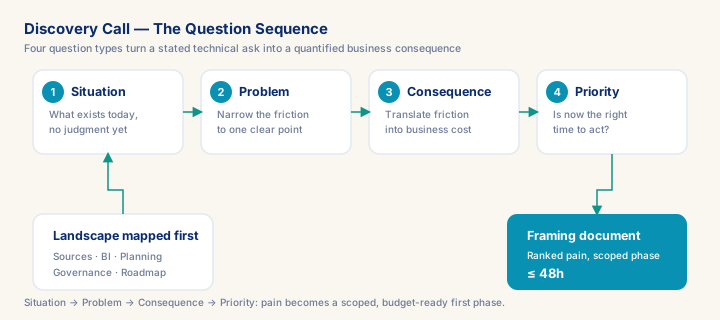
Discovery is where the deal is actually won or lost: a consultant who spends roughly 70 percent of the call listening — not presenting — walks away with a quantified business consequence, not a feature request. That single artefact, a one-page framing document sent within 48 hours, is what separates a proposal compared on day rate from one compared on trust. The stake is direct: a business case built on a named cost (hours lost, decisions delayed, an executive pack pushed) supports a premium rate; a proposal built on a feature list gets shopped against the cheapest bidder. This module trains the four-question sequence — situation, problem, consequence, priority — that turns "we need to migrate off BW" into a budget-ready first phase.
What you will learn
- Run a structured SAP analytics discovery call that achieves a 30/70 speaking ratio and surfaces the real business pain behind the stated technical requirement
- Apply the four-question sequence — situation, problem, consequence, priority — to move from a stated issue such as a BW migration request to a quantified business consequence that can anchor an internal budget case
- Map a client's existing SAP landscape across five domains (data sources, BI layer, planning layer, data governance, and strategic roadmap) using non-threatening procedural questions
- Produce a 48-hour post-call framing document that ranks pain by business impact, proposes a scoped first phase, and positions the full proposal conversation around value rather than tool features
What a Discovery Call Is Actually For
A discovery call is not a product demonstration. It is not a capabilities presentation. It is not a reference-exchange session where you tell the prospect what you have done and they tell you what they want. It is a structured diagnostic conversation whose job is to surface three things: the real problem (which is almost never the stated problem), the organisational dynamics around it, and the business cost of not solving it.
In SAP analytics, the stated problem is usually technical: «We need to migrate off BW», «We want to implement SAC planning», «We're evaluating Datasphere». The real problem is always business: finance cannot produce a reliable month-end pack without three days of manual reconciliation; the CFO asked for margin-by-customer and IT told her it would take four months; the data team is rebuilding the same BW query for the third time because requirements keep shifting. Your job in discovery is to get from the stated technical ask to the underlying business pain — and then to map the cost of that pain in terms the client's economic buyer cares about.
Prerequisites
- Review core concepts first: C012, C094, C091
Outcomes
- Master the SPIN framework in SAP analytics discovery contexts.
- Use strategic silence to let prospects reveal their real pain.
- Apply the module's core decision: Who leads the discovery call — you alone, or you plus a technical SME — choose Lead solo for the first call to protect the 30/70 listening ratio.
- Track mastery with the KPI: Listening ratio (target: Client speaks >= 60% of call time; red flag: Consultant speaks more than half the call — the call was a presentation, not a discovery).
Full module available to members. The full module adds: the decision framework · the end-to-end scenario walkthrough · the KPI scorecard · the anti-patterns · the knowledge check · the diagrams.