Cash Investing: Making Company Reserves Work
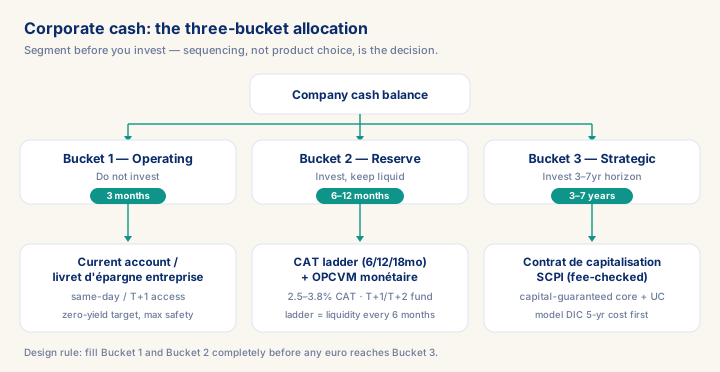
As of 2026-10-04
A SASU or EURL sitting on €150,000–€400,000 of accumulated reserves loses €3,000–€12,000 a year in real terms by leaving it in a current account — two to three billing days evaporating annually for nothing. The fix is not a single product; it is sequencing: segment cash into three buckets (operating, reserve, strategic) before choosing between a compte à terme (2.5–3.8% fixed, mid-2025), a money-market fund (2.5–3.0% and falling with ECB rates), or a contrat de capitalisation for the genuinely long-horizon portion. Get the sequencing wrong — investing reserve cash in an illiquid SCPI, or over-distributing the buffer to save 25% IS — and a four-month contract gap turns into a cash crisis instead of a non-event. Consultants who run this discipline negotiate from security rather than urgency, and that shows up directly in day-rate defense.
What you will learn
- Bucket company cash into three tiers (operating, reserve, strategic) with defined thresholds before investing any surplus
- Select between compte à terme, OPCVM monétaire, and contrat de capitalisation based on horizon and liquidity needs
- Evaluate the risk of over-distributing reserves relative to the tax efficiency gain
- Rebalance cash allocation quarterly as contract pipeline and rate environment evolve
The Problem With Letting Cash Sit
A SASU or EURL operating account holding €80,000 in a standard business current account at a French bank is losing purchasing power at approximately 2–3% per year in a 2–3% inflation environment, against a zero nominal return. At €80,000, that is €1,600–€2,400 per year in real erosion — equivalent to two to three billing days simply evaporating from the balance. The money is not safe; it is slowly declining in real terms while the bank uses it to generate returns elsewhere.
This problem compounds across the career of an SAP consultant who runs a successful practice. After five to seven years of sustained billing, a SASU or EURL can accumulate €150,000–€400,000 or more in corporate reserves, particularly if the founder has managed cash prudently, avoided large premature distributions, and retained earnings as a buffer against market cycles. At that scale, the erosion is €3,000–€12,000 per year. The question of what to do with corporate cash becomes material.
Prerequisites
- Review core concepts first: C074, C070, C092
Outcomes
- Select between compte à terme, OPCVM monétaire, and contrat de capitalisation based on horizon and liquidity needs.
- Allocate cash across three buckets: operating (3 months), reserve (6-12 months), strategic (3-7 years).
- Size the real cost of leaving reserves idle and the fee drag of wrapped products before recommending a placement.
- Apply the bucket framework to a real SASU/EURL balance in a 15-minute lab format.
Full module available to members. The full module adds: the decision framework · the end-to-end scenario walkthrough · the KPI scorecard · the anti-patterns · the knowledge check · the diagrams.