Preparing for a Tax Audit
As of 2026-10-04
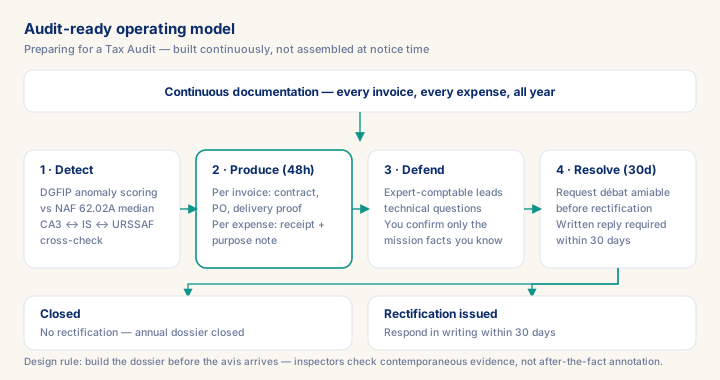
A contrôle fiscal is a statistical certainty for any freelance SAP consultant billing above roughly €100,000 a year — not a sign of wrongdoing, but a test of whether your paperwork survives DGFIP's automated anomaly scoring. The stakes are concrete: a rejected deduction plus penalties can erase a full month of billings, and the délai de reprise lets the tax authority reach back three years — ten in cases of fraud. This module gives you the trigger list DGFIP actually screens for, the exact evidence set you must be able to produce within 48 hours of an avis de vérification, and the procedural rights — débat amiable, 30-day response window — that decide whether a rectification sticks. Being audit-ready is also a sales argument: clients billing at €900+/day increasingly ask about compliance posture before signing, and a clean answer closes that question in one sentence.
What you will learn
- Identify the triggers that cause the French tax authority (DGFIP) to open a contrôle fiscal on a one-person consultancy
- Build and maintain the audit-ready documentation set throughout the year — not just at notice time
- Understand the procedural rights and obligations during an audit and when to invoke them
- Coordinate effectively with your expert-comptable before, during, and after an inspection
Disclaimer: this module is for general information only. French tax rules are complex, evolve through annual finance laws and case law, and their application depends on your specific legal structure, revenue, and situation. Nothing here is professional tax or legal advice. Always work with a licensed expert-comptable and, for disputes, a fiscal lawyer (avocat fiscaliste).
A contrôle fiscal is not a sign that you have done something wrong. For a freelance SAP analytics consultant billing €100,000–250,000/year, a periodic review by the DGFIP (Direction Générale des Finances Publiques) is a statistical reality, not an indictment. The question is not whether you might face one, but whether your records are in shape when you do.
What actually triggers an audit
Anomaly signals in your tax filings are the primary trigger. The DGFIP's automated scoring compares your declared revenue, charges, and VAT against statistical norms for your NACE code and legal form. For IT consultants (NAF 62.02A), the ratio of deductible charges to revenue is benchmarked against thousands of similar firms. If your charges-to-revenue ratio sits at 60% while the median for your code is 25%, the gap needs to be explained by your activity, not luck.
Prerequisites
- Intermediate hands-on experience on SAP analytics projects
- Review core concepts first: C075, C065, C045
Outcomes
- Organize 10 years of accounting records in a structured archive.
- Build an expense audit trail with bank statements, receipts, purpose notes.
- Apply the module's core decision: When to build the audit-ready dossier — choose Build the evidence file continuously, invoice by invoice, from your first fiscal year.
- Track mastery with the KPI: Documentation completeness (target: 100% of sampled invoices have the full evidence set).
Full module available to members. The full module adds: the decision framework · the end-to-end scenario walkthrough · the KPI scorecard · the anti-patterns · the knowledge check · the diagrams.