Wealth Building in France: Real Estate & SCI
As of 2026-10-06
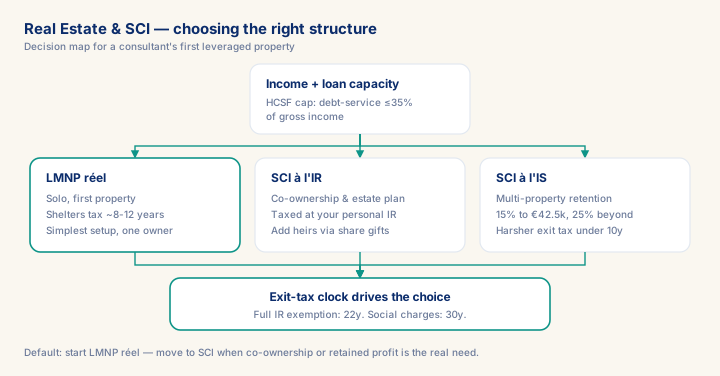
Real estate is the one asset class that converts an SAP consultant's volatile day-rate income into a predictable, leveraged, tax-sheltered balance sheet. The first decision is structural: LMNP réel for a solo first property (depreciation typically zeroes out taxable rental income for 8–12 years), SCI à l'IR for co-owned or family-held property, or SCI à l'IS only when profits will be retained and the hold is 10+ years — the IS election trades a lower running tax rate (15% up to €42,500, 25% beyond) for a harsher capital-gains bill on exit. The number that anchors every financing conversation is the HCSF debt-service cap: 35% of gross income across all loans, which for a consultant netting €9,000/month leaves roughly €1,950/month of investment-property capacity after a typical primary-residence mortgage. Consultants who build a €3,000–€5,000/month rental income base change their own rate negotiation: they can decline underpriced missions because part of their fixed costs is already covered.
What you will learn
- Distinguish SCI IR, SCI IS, and LMNP réel to select the right structure for a first investment property
- Calculate the annual fiscal impact of LMNP depreciation on meublé rental income using a concrete case
- Present a compliant loan application to a French bank as a TNS consultant using three years of tax returns
- Model the cash-flow and exit-tax timeline for a buy-and-hold strategy over 20 years in France
Why Real Estate Fits the Consulting Income Profile
Consulting income is volatile; real estate leverage is not. A senior SAP consultant billing at €750–€1,100/day generates irregular cash flows — feast during active missions, famine between engagements. Real estate invested with proper leverage converts that irregular income into a predictable, compounding asset. The key insight is that banks lend against demonstrable professional income, not balance sheets. An auto-entrepreneur or SASU holder with three years of client invoices showing €120,000+ of annual revenue can access property loans on terms comparable to senior executives — provided the debt-service ratio (taux d'endettement) stays below the HCSF (Haut Conseil de Stabilité Financière) threshold, currently 35% of gross income including existing credit charges.
For a consultant earning €9,000/month net, the HCSF cap permits approximately €3,150/month in total loan repayments. If you already carry a primary residence mortgage of €1,200/month, you have approximately €1,950/month available for investment property debt service — supporting a loan of roughly €400,000–€450,000 at current rates (4–4.5% fixed over 20 years as of early 2026 in France). That is meaningful purchasing power.
Prerequisites
- Intermediate hands-on experience on SAP analytics projects
- Review core concepts first: C074, C092, C079
Outcomes
- Choose between direct ownership, SCI, SCI-IS, and SAS immobilière.
- Use LMNP status to reduce tax on rental revenue.
- Apply the module's core decision: Which structure for a first investment property — choose LMNP réel when buying alone for the first time.
- Track mastery with the KPI: Debt-service ratio (taux d'endettement).
Full module available to members. The full module adds: the decision framework · the end-to-end scenario walkthrough · the KPI scorecard · the anti-patterns · the code blocks · the knowledge check · the diagrams.