Active Listening: The 6 Levels
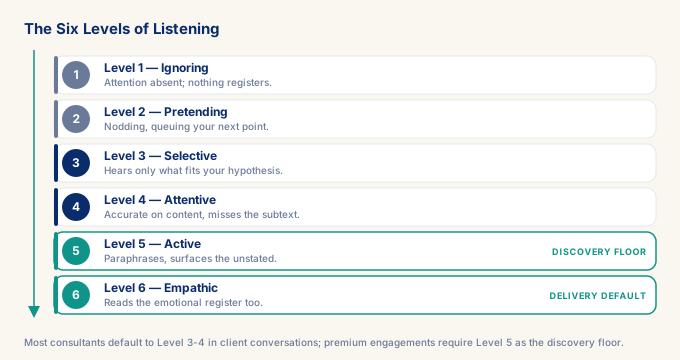
As of 2026-10-03
Active listening is a six-level model, not a soft-skill platitude: Level 3 (selective listening) is where most consultants operate by default, and it is why discovery workshops routinely produce requirements documents that miss the real business problem by an abstraction layer or two. The module gives five concrete Level-5 techniques for discovery -- the 3-second pause, paraphrase-before-proposing, the unasked question, emotional labelling, the silence hold -- and three Level-6 signals to read in delivery: participation shift, language precision shift, and the abstract retreat. The commercial stake is direct: the most expensive failure mode in SAP analytics engagements is building the wrong solution because the real problem was never surfaced, and that failure costs more than the gap between a premium day rate and a discount one. A consultant who demonstrably listens at Level 5 in a first discovery call leaves with a richer problem definition, a better-scoped proposal, and fewer change requests than a peer stuck at Level 3.
What you will learn
- Distinguish the six listening levels from ignoring to empathic listening, and self-diagnose which level you operate at by default in discovery and in delivery
- Apply five Level-5 techniques in SAP analytics discovery workshops: the 3-second pause, paraphrase-before-proposing, the unasked question, emotional labelling, and the silence hold
- Read Level-6 signals in delivery settings -- participation shift, language precision shift, and the abstract retreat -- and adjust facilitation in real time
- Identify the three most common listening failure modes in consulting contexts and use disconfirmation as the structural antidote
Why Consultants Think They Listen When They Do Not
Listening is assumed. It is the default activity when someone else is talking. But assumed listening is the weakest form -- ears open, mind composing the response, eyes tracking the room, pattern-matching to a solution before the client has finished describing the problem. In SAP analytics work, this failure mode is expensive. A discovery workshop where the consultant listens at Level 2 while the client is speaking at the level that would produce Level 5 information produces a requirements document that misses the actual business problem by two abstraction layers.
The six-level model -- from ignoring to empathic listening -- is not academic. It is a diagnostic tool for understanding why a client conversation produced bad information, and a deliberate practice for producing better information in the next one.
Prerequisites
- Review core concepts first: C083, C079, C058
Outcomes
- Work through a realistic scenario: A mid-size European industrial manufacturer asks its SAP analytics consultant to scope a BW-to-Datasphere migration plan.
- Recognize and avoid the anti-pattern: Closed question disguised as engagement ("Does that make sense?") — Invites a reflexive yes, produces no real information.
- Apply the module's core decision: Which listening level to operate at, live — choose Default to Level 5 in discovery, drop to Level 4 for fast structured technical exchanges (demos, spec confirmation).
- Track mastery with the KPI: Discovery information yield (target: At least one unasked constraint or political signal surfaced per workshop).
Full module available to members. The full module adds: the decision framework · the end-to-end scenario walkthrough · the KPI scorecard · the anti-patterns · the knowledge check · the diagrams.