Storytelling: The Pixar Formula for Consultants
As of 2026-10-03
Most SAP analytics readouts fail because they are «and» documents — a pile of findings with no tension to force a decision. This module teaches the and/but/therefore structure Pixar's story team uses to kill weak pitches before a single slide is built, and applies it to business cases, go-live readouts, and rate conversations. The test is concrete: if you cannot state your recommendation as a five-sentence ABT, the analysis is not finished. Consultants who can deliver that spine out loud, under pressure, in under a minute are demonstrating the composure that justifies a senior day rate — those who cannot are still operating at analyst level regardless of title.
What you will learn
- Apply the Pixar 'and/but/therefore' spine to structure any consulting narrative — business case, readout, or executive brief
- Identify and eliminate the three most common consulting narrative failures: data dumps, solution-first openings, and passive story arcs
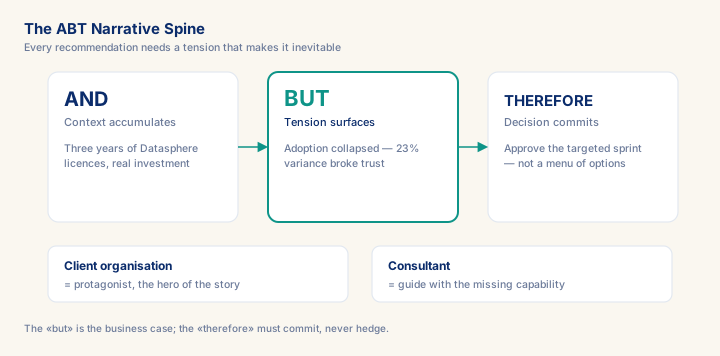
- Build a character-driven consulting story where the client organisation is the protagonist and the consultant is the guide
- Craft a closing 'therefore' that commits to a specific recommendation rather than a menu of options
Why Pixar's storytelling engine works for consultants
Pixar's story artists use a three-beat engine to test every plot before a single frame is drawn: and / but / therefore (ABT). The structure was formalised by marine biologist and filmmaker Randy Olson as a communication template; it is often taught alongside Pixar-style story exercises, but it is not a documented internal Pixar tool, so this module uses Pixar as shorthand for causal storytelling, not as a claim about Pixar's process. It works because it forces causality. «And» accumulates context. «But» introduces tension — the problem that makes action necessary. «Therefore» delivers consequence — the logical action that follows.
Most consulting narratives fail not because the analysis is wrong but because they are built on «and … and … and». A SAP analytics readout that lists five findings, three risks, and four recommendations without a spine is an «and» document. The audience walks out knowing what you said but not what they should feel or do. ABT forces the consultant to answer the structural question before opening PowerPoint: what is the tension that makes my recommendation inevitable?
The ABT structure in its raw form
The template is deceptively simple:
Prerequisites
- Review core concepts first: C083, C079, C058
Outcomes
- Work through a realistic scenario: A DACH chemicals group has stalled its SAP Datasphere migration in Phase 2: the finance team reverted to Excel after the new semantic layer produced a 23% variance against.
- Recognize and avoid the anti-pattern: Burying the «but» in slide 18 — By the time the tension appears, the executive has mentally left the room — the recommendation lands on an empty audience.
- Apply the module's core decision: Which narrative structure to use in a client deliverable — choose Default to and/but/therefore whenever a specific decision is being asked for — business case, readout.
- Track mastery with the KPI: Time-to-tension (target: The «but» is stated within the first 3 minutes or by slide 2; red flag: Tension appears after slide 10, or is never explicitly stated).
Full module available to members. The full module adds: the decision framework · the end-to-end scenario walkthrough · the KPI scorecard · the anti-patterns · the knowledge check · the diagrams.