Documentation That Survives Team Rotation
As of 2026-10-03
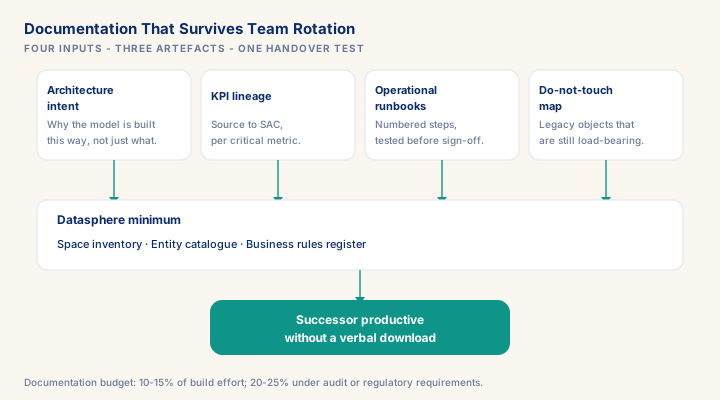
Documentation That Survives Team Rotation is the difference between a Datasphere landscape a successor can run from day one and one that needs the original team on call for eighteen months. The module gives four categories worth documenting — architecture intent, KPI lineage, operational runbooks, and the "do not touch" map — instead of everything the system already records for you. On time-and-material engagements, budget 10-15% of implementation effort for it, rising to 20-25% under a regulated or audited environment; on fixed-price statements of work, it needs an explicit, sign-off-bound scope line or it becomes a dispute at project close. For a senior SAP analytics consultant, demonstrable documentation quality is a retention lever: a client who depends on a contractor for institutional knowledge has a real incentive to renew rather than pay the onboarding cost of a successor starting from zero.
What you will learn
- Identify the four categories of SAP analytics project knowledge that must be documented to survive team rotation and explain what makes each category irreplaceable
- Build the three minimum-viable documentation artefacts for a Datasphere implementation — space inventory, entity catalogue, and business rules register
- Write operational runbooks for recurring SAP analytics processes that a successor can execute successfully on first attempt without author support
- Scope and price documentation deliverables correctly in fixed-price and time-and-material SAP analytics contracts
The Documentation That Gets Left Behind
Every SAP analytics programme produces two kinds of knowledge: the knowledge that lives in the system, and the knowledge that lives in the heads of the people who built it. When those people leave — at the end of a project, at contract renewal, through attrition — the second category evaporates. What remains is a Datasphere landscape with 400 transformation views, a BW/4HANA InfoProvider hierarchy that nobody can explain, and a set of SAC stories whose data models are technically functional but unmaintainable by anyone who wasn't in the room when the business rules were negotiated.
Documentation that survives team rotation is not documentation that covers everything. It is documentation that covers the right things at sufficient depth, written for the specific audience that will need it in 18 months, when the original team has dispersed and a new contractor is onboarded on day one of a critical enhancement cycle.
Prerequisites
- Intermediate hands-on experience on SAP analytics projects
- Review core concepts first: C058, C047, C087
Outcomes
- Work through a realistic scenario: A mid-market pharmaceutical manufacturer is six weeks from a Datasphere and SAC go-live.
- Recognize and avoid the anti-pattern: Documenting what the system already documents — Field definitions and object metadata get duplicated into Word files that drift from the system within about six months.
- Apply the module's core decision: What to document first when a rotation is coming — choose Default to the four categories that are not recoverable from the system: architecture intent, KPI lineage.
- Track mastery with the KPI: Critical-KPI lineage coverage (target: 100% of the 10-15 business-critical KPIs traced end to end).
Full module available to members. The full module adds: the decision framework · the end-to-end scenario walkthrough · the KPI scorecard · the anti-patterns · the knowledge check · the diagrams.